

What is hard water? (and is it bad for you)
Share
Your kettle furs up and the shower screen never shines, yet a friend in Manchester has never descaled anything. What is hard water, and does it matter beyond the kitchen?
Short answer: hard water carries a lot of dissolved calcium and magnesium. The Drinking Water Inspectorate (DWI) calls 200 to 300 mg/l hard and over 300 very hard, and says UK regulations set no standard for hardness. Its map shows the south and east of England mostly hard, the north and west softer. Your water company publishes your zone's figure.
By Andrew Tomlinson, WaterKit · Last reviewed 25 October 2026
What is hard water?
It is water that has picked up a lot of dissolved calcium and magnesium on its way to your tap. The DWI says hardness is caused by dissolved calcium and magnesium and varies with local geology. Rain starts out soft. United Utilities says hard water forms when water passes through or over limestone or chalk and those minerals dissolve into it, and Southern Water adds that areas with granite or peat have softer water.
United Utilities describes two parts. Temporary (carbonate) hardness forms scale when water is boiled, which is the crust on a kettle element. Permanent hardness, made up of calcium and magnesium sulphate, does not form scale when heated. Hardness is usually given in milligrams per litre of calcium carbonate (mg/l CaCO3), which United Utilities says is the same as parts per million, although some companies use degrees or mg/l of calcium instead.
How hard is "hard"?
The DWI puts the line for hard at 200 mg/l. Its table, with United Utilities' finer split of the soft band and its Clark degrees, looks like this.
| mg/l calcium carbonate | DWI band | United Utilities label | Degrees Clark (United Utilities) |
|---|---|---|---|
| 0 to 50 | Soft | Soft | 0 to 3.5 |
| 51 to 100 | Soft | Moderately soft | 3.6 to 7.0 |
| 101 to 150 | Slightly hard | Slightly hard | 7.1 to 10.5 |
| 151 to 200 | Moderately hard | Moderately hard | 10.6 to 14 |
| 201 to 300 | Hard | Hard | 14.1 to 21 |
| Over 300 | Very hard | Very hard | Over 21 |
There is no single scale. United Utilities says there are no universally agreed criteria for hard or soft water. Southern Water calls anything under 100 mg/l soft and 100 to 200 moderately hard, and a World Health Organization (WHO) background document, citing a 2000 source, treats under 60 mg/l as soft and over 180 as very hard. So a label on a lookup page can differ from the band your figure falls in.
The DWI also repeats the WHO's two rules of thumb. Water of 200 mg/l or more will produce scale, and soft water of 100 mg/l or less will be more corrosive to pipework.
Why is UK water hard in some places and soft in others?
Geology, going by the DWI and the British Geological Survey (BGS). The DWI publishes a map of typical hardness across England and Wales, though its footer is dated 2009 and the DWI says to ask your water company for an accurate figure because some local variation is not shown on it. The table is our reading of that map, with the reason each source gives.
| Where | What the DWI map shows (our reading) | Why, according to the sources |
|---|---|---|
| East Anglia, Lincolnshire and East Yorkshire | Large areas very hard, over 300 mg/l | The BGS says Anglian Water's groundwater is mainly from the Chalk aquifer |
| The south-east, much of the south and parts of the Midlands | Mostly hard, 201 to 300 mg/l, with softer patches | The BGS says south-east companies, where groundwater is over 75 per cent of supply, rely heavily on the Chalk. Southern Water says most of its water is hard because it comes from underground chalk aquifers |
| Wales, Devon and Cornwall and the North West | Mostly soft, 0 to 50, or moderately soft, 51 to 100 | United Utilities' register gives the Lake District as the source for central Manchester. Southern Water says places with granite or peat have softer water |
Scotland is outside that map. Its regulator, the Drinking Water Quality Regulator (DWQR), says chalk and limestone rocks hold the most of these minerals but are not common in Scotland, so most supplies are classed as soft. For Northern Ireland, NI Water says its water quality results tool shows hardness for your area.
If you want towns rather than regions, our guide to the hardest tap water in the UK ranks the hardest zones we found in company figures, and the water hardness by town pages give North West figures.
Is my water hard or soft?
Find your water company's figure for your postcode and read it against the bands above. The everyday signs, as the DWI lists them, are scale in kettles and hot water systems, less lather from soap, washing-up liquid and washing powder, tide marks on basins, baths and toilets, and a scum on hot drinks, especially tea brewed in the cup.
The figure is for a supply zone, not your house. Two worked examples, read on 25 October 2026. United Utilities' register gives the zone covering one central Manchester postcode (M2 5DB, Broughton) as 1.96 degrees Clark, labelled soft, which is about 28 mg/l. Yorkshire Water's zone report for Hull Central West gives 147.3 mg/l as calcium for 2025, labelled very hard, which is about 368 mg/l as calcium carbonate. That is a gap of more than a factor of ten, within England.
Our guide to checking water hardness by postcode walks through each company's lookup, and How hard is my water? covers what to do with the number.
Is hard water bad for you?
The official bodies we read set no health limit for hardness. The DWI says the UK drinking water quality regulations do not specify standards for hardness, calcium or magnesium. The WHO gives its reason for setting no guideline value as "not of health concern at levels found in drinking-water", and says drinking water can add to calcium and magnesium intake.
On heart health the WHO says the evidence for a protective effect of magnesium or hardness on cardiovascular mortality is being debated and does not prove causality. The DWI says there is some limited evidence of a relationship between hardness and cardiovascular health, and recommends that water companies that artificially soften water before supplying it keep a minimum total hardness of 150 mg/l.
The DWQR describes the slight scum that hard water can leave on tea as harmless.
What does hard water do to kettles, boilers and soap?
It builds scale and cuts lather. The DWI says scaling is deposits of calcium and magnesium that build up on heating elements, shortening their life and making appliances less efficient, and that hard water produces less lather from soap, washing-up liquid and washing powders. The WHO makes the same point about heated water and heat exchangers.
For boilers, the building guidance for England goes further. Approved Document L, in its 2021 edition with 2023 amendments (paragraph 8.8), says that in hard water areas suitable measures should be taken to treat the feed water to water heaters and the hot water circuit of combination boilers to reduce limescale. It defines hard water as total hardness above 200 ppm of calcium carbonate. The 2026 edition, which takes effect on 24 March 2027 for building work not in connection with higher-risk building work, repeats the wording at paragraph 7.8. It applies when a new heating appliance is installed, not to a boiler you already have. We found no UK official figure for what scale costs a household.
The kettle is where most of us see it. Our kettle limescale guide shows what each band tends to look like in use.
How do I convert degrees Clark to mg/l?
Multiply by about 14.3. United Utilities' 2025 factsheet gives the factors for converting from mg/l of calcium carbonate, and the multipliers below are our arithmetic turning them round.
| If your figure is in | Multiply by | To get mg/l calcium carbonate |
|---|---|---|
| Degrees Clark (English) | 14.3 | For example 15 degrees Clark is about 214 mg/l |
| French degrees | 10 | For example 20 degrees is 200 mg/l |
| German degrees | 17.8 | For example 10 degrees is about 178 mg/l |
| mg/l as calcium | 2.5 | For example 80 mg/l is 200 mg/l |
So the Manchester figure above is 1.96 x 14.3, about 28 mg/l, and the Hull figure is 147.3 x 2.5, about 368 mg/l.
Can I soften it?
Yes, and the DWI calls whether to do so a matter of personal choice. It says a softener in a hard water area will improve the efficiency and increase the life of domestic appliances, make lathering easier and reduce tide marks. Most domestic softeners swap calcium and magnesium for sodium, so the DWI says not to soften the kitchen tap you use for drinking and cooking. Our guide Do I need a water filter or a water softener? compares the options.
How can a test strip help?
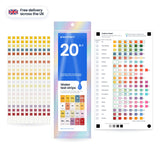
It shows the hardness band at your own tap, which a zone figure cannot. The WaterKit Water Test Kit has a hardness pad on its 20-in-1 strip. Fill the sample tube from the cold tap, dip one strip, wait 30 to 60 seconds and match the pad to the chart. The pad reads in steps of 0, 25, 50, 100, 250 and 425 mg/l, and the results portal names the band. This table is our reading of the chart steps against the DWI's bands, not a claim from the DWI.
| Chart step | What it indicates against the DWI bands |
|---|---|
| 0, 25 and 50 mg/l | Soft |
| 100 mg/l | Soft, at the top of the DWI's soft band (the results portal names this step moderately soft, using United Utilities' split at 50) |
| 250 mg/l | Hard, which is 200 to 300 |
| 425 mg/l | Very hard, over 300 |
| A colour between the 100 and 250 steps | Somewhere from 101 to 250, which spans slightly hard, moderately hard and the start of hard |
The pad gives one total hardness band. It does not split the result into calcium and magnesium, or into temporary and permanent hardness. Your water company's zone figure stays the reference number for your area. Comparing the two is useful, because a tap that differs from its zone figure may be telling you something about your own plumbing or a softener. If you fit one, test a softened tap and your unsoftened kitchen tap and the strip should show the difference.
Best pack: 50 strips, enough to test now and again after any change, £8.99 (or £13.99 with a bacteria test), with free 2nd Class delivery on every order. See the kit
Your hard water questions
What is hard water?
Water with a lot of dissolved calcium and magnesium, usually picked up from chalk or limestone. The DWI calls 200 to 300 mg/l of calcium carbonate hard.
Is hard water bad for you?
The official sources we read report no hardness standard in the UK regulations and the WHO says hardness is not of health concern at the levels found in drinking water. They do list effects on scale and lather. See the section above for who says what.
Is my water hard or soft?
Look up your postcode on your water company's website and compare the figure with the bands above. Under 100 mg/l is soft in the DWI's table and over 200 mg/l is hard.
Do I live in a hard water area?
The DWI map shows large parts of the south and east of England as hard or very hard, and much of Wales, Devon and Cornwall and the North West as soft or moderately soft. Check your own postcode, because the map does not show local variation.
How hard is the water in my area?
Ask your water company, which publishes a figure for each supply zone. Our postcode guide lists the lookups.
Am I in a hard water area?
Check your postcode with your water company, then compare. The DWI calls 200 to 300 mg/l hard and over 300 very hard, and 100 to 200 mg/l slightly or moderately hard.
How hard is my water in the UK?
It varies by zone, from soft to very hard. On 25 October 2026 we read about 28 mg/l for central Manchester and about 368 mg/l for Hull Central West, and our guide to the hardest tap water in the UK lists more.
Everything in our hard water guide
- How hard is my water?
- How to check your water hardness by postcode
- Why does my kettle get limescale?
- Which UK town has the hardest tap water?
- Is Manchester water hard or soft?
- Do I need a water filter or a water softener?
- Is limescale bad for you?
- Can you drink water from a water softener?
- How much does a water softener cost, and is it worth it?
- What is limescale, and what causes it?
- Is hard water bad for you?
- How do you soften hard water at home?
- Why is London water so hard? Chalk, the Thames and what the water company zone reports show.
- Why is toilet limescale brown? Iron, manganese and hardness as the DWI describes them.
- Do I need dishwasher salt in a soft water area? What water companies and Which? say about salt and soft water.
- Is Scottish water hard or soft? Zone figures from Scottish Water's 2024 hardness data.
- Is the water in Yorkshire hard or soft? 2025 zone figures from soft to very hard.
- What water should you put in a steam iron? What iron makers and Which? say, and the DWI on scale in irons.
- Is Birmingham water hard or soft? Zone figures for the city on Severn Trent's checker, and where the supplier changes.
Sources
- Drinking Water Inspectorate, Water Hardness / Hard Water (bands, geology, scaling and lather, no standard for hardness, WHO 200 and 100 mg/l, 150 mg/l for softened supplies, softener advice; read 25 October 2026) and its hardness map (typical hardness in England and Wales, footer dated 2009; read 25 October 2026).
- United Utilities, Water hardness factsheet 2025 (limestone and chalk, temporary and permanent hardness, units and conversion factors, six bands and Clark ranges, no universally agreed criteria; read 25 October 2026) and its water quality search (M2 5DB, Broughton zone Z284, hardness level Soft, 1.96 Clark, water from the Lake District, register updated 23 October 2026; read 25 October 2026).
- Southern Water, How hard is my water? (granite and peat, chalk aquifers, its own bands; read 25 October 2026).
- Yorkshire Water, Water hardness (postcode HU1 1AA, Hull Central West, report period 1 January to 31 December 2025, "Very hard", 147.3 mg/l calcium; read 25 October 2026).
- British Geological Survey, Groundwater resources in the UK (Chalk, south-east England over 75 per cent groundwater, Anglian Water mainly Chalk; read 25 October 2026).
- Drinking Water Quality Regulator for Scotland, Water Hardness (most Scottish water soft, chalk and limestone not common, scum on hot drinks; read 25 October 2026). NI Water, Water quality (results tool covers hardness; read 25 October 2026).
- World Health Organization, Hardness chemical fact sheet (not of health concern, calcium and magnesium intake, cardiovascular evidence debated; read 25 October 2026) and Hardness in drinking-water, background document (its own bands, scale and heat exchangers; read 25 October 2026).
- The Water Supply (Water Quality) Regulations 2016, full text (as made, no hardness parameter; read 25 October 2026).
- gov.uk, Approved Document L, Volume 1 Dwellings, 2021 edition incorporating 2023 amendments (paragraph 8.8 and the definition of hard water) and 2026 edition, Energy and greenhouse gas emissions (paragraph 7.8, effective 24 March 2027; read 25 October 2026).
- WaterKit, Water Test Kit (20-in-1 strip, 30 to 60 second read, from £3.99, free 2nd Class delivery on every order, 30-day money-back guarantee) and results portal. The strip-chart table and the degree conversion multipliers are WaterKit's own reading and arithmetic.
Contains public sector information licensed under the Open Government Licence v3.0.