

Is Yorkshire water hard or soft?
Share
Part of our hard water guide
Two zone reports, two hard readings, and a tap that may not match either. You can check where yours sits with a 20-in-1 test strip.
Short answer: In the two 2025 zone reports we read for Yorkshire, hard to very hard. Hull Central West averaged 147.3 mg/l as calcium, about 368 as calcium carbonate by our conversion, in the DWI's very hard band. York South averaged 111.6, about 279, which is hard. The company says hardness may occasionally vary.
By Andrew Tomlinson, WaterKit · Last reviewed 29 October 2026
How hard is the water in the Yorkshire zones we read?
Hard to very hard in both. In Yorkshire Water's reports for 1 January to 31 December 2025, the Hull Central West zone (population 27,542) averaged 147.3 mg/l total hardness as calcium. The York South zone (population 48,060) averaged 111.6. The company calls Hull Central West very hard and York South hard to very hard. You can see where your own tap falls with a 20-in-1 test strip.
The reports give hardness in mg/l as calcium. The Drinking Water Inspectorate (DWI) gives its bands in mg/l as calcium carbonate, so we multiplied by 2.5 to compare. That conversion is ours. The DWI calls up to 100 soft, 100 to 150 slightly hard, 150 to 200 moderately hard, 200 to 300 hard and more than 300 very hard.
| Zone (2025 report) | Company's description | Average, mg/l as calcium | Lowest sample, mg/l as calcium | Average as calcium carbonate (ours) | DWI band (ours) |
|---|---|---|---|---|---|
| Hull Central West | Very hard, borehole/river derived | 147.3 | 143 | about 368 | Very hard |
| York South | Hard to very hard, river derived | 111.6 | 82.6 | about 279 | Hard |
Each average comes from the Total Hardness row, which is eight samples. The reports' text layer is scrambled, so we show only the values we could read clearly. The reports list no standard for hardness, and the DWI says the UK drinking water quality regulations specify none for hardness, calcium or magnesium. We read two zones, not every Yorkshire Water zone.
Why does hardness differ from place to place?
Because it depends on local geology, says the DWI, which explains that hardness is caused by dissolved calcium and magnesium. The two reports describe Hull Central West as borehole and river derived and York South as river derived.
Does Yorkshire Water soften its water?
No. Yorkshire Water says it does not soften water at any of its treatment plants, and that whether to fit a softener at home is your choice. It says a home softener must be in line with the Water Supply (Water Fittings) Regulations 1999, and that you must keep an unsoftened supply for drinking because softening adds sodium. The DWI gives the same advice. Our filter or softener guide covers the decision.
Why might the water at my tap differ from the zone average?
The area figure is an average. Your tap may read higher or lower, and the sources give three reasons.
- Spread. York South's lowest sample was 82.6 mg/l as calcium, about 207 as calcium carbonate by our arithmetic, against a mean of 111.6.
- Moving water. Both reports say Yorkshire Water has a grid that can move water around the region, so the hardness of your water may occasionally vary.
- Local variation. The DWI says there are areas with local variation that its map of typical hardness does not represent, and that for an accurate measurement you should ask your water company.
A figure for the area does not tell you what comes out of your own tap.
“Treat the area figure as a starting point, not a verdict on your own kitchen tap. Yorkshire Water says it can move water around the region, and the DWI says its map does not represent every local variation, so a quick strip at your own tap is a sensible way to see where you actually sit.”
It matters in the kitchen. The DWI says hard water causes scaling in hot water systems, kettles, electric irons and appliances, which shortens heating element life and makes appliances less efficient. It says temporary hardness is removed by boiling, forming scale, which is the crust described in our kettle limescale guide. It adds that WHO guidelines identified 200 mg/l or more as calcium carbonate as producing scale. By our conversion both zone averages are above that. A strip dipped at your own tap shows which band the water reads on the day.
How can I check the hardness at my own tap?
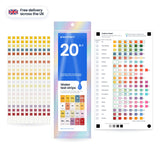
Fill a clean glass or cup with tap water, dip one strip, wait 30 to 60 seconds and match the pads to the chart, or enter the colours in the free results checker. Yorkshire Water says it can provide detailed hardness information for your area on request, and our hardness by postcode guide covers other companies. Our hardness testing guide has the full method.
The hardness pad has colour steps at 25, 50, 100, 250 and 425 mg/L. The unit basis is unconfirmed, so the next lines are our own reading as calcium carbonate, not Yorkshire Water's or the DWI's. Hull Central West's 368 would sit between the 250 and 425 steps, nearer 425. York South's 279 would sit closest to 250. The pad indicates a band, so it cannot separate 270 from 280, and one dip at one tap is not a zone average. It cannot split temporary from permanent hardness, and a strip result is not a legal sample. Repeating the dip on a few days shows how steady your tap is.
Best pack: 20 strips, enough to read your kitchen tap on several days and compare it with the zone figures above, £5.99 (or £10.99 with a bacteria test), with free 2nd Class delivery on every order. See the kit
Your Yorkshire water hardness questions
Is Yorkshire water hard or soft?
In the two 2025 zone reports we read, hard to very hard. Yorkshire Water calls Hull Central West very hard and York South hard to very hard, and says hardness may occasionally vary because it can move water around the region. We read no other zones, so for yours check the company's hardness page or test your tap.
Is Leeds water hard or soft?
The sources we read do not include a Leeds zone, so we give no Leeds figure here. Yorkshire Water says it can provide detailed hardness information for your area on request. Our hardness by postcode guide shows how to look it up.
Sources
- Drinking Water Inspectorate, Water hardness / hard water (calcium and magnesium; varies with local geology; bands in mg/l calcium carbonate; no UK standard for hardness; map and local variation; scaling; temporary hardness; WHO 200 mg/l; softeners swap in sodium; undated page; read 29 October 2026).
- Yorkshire Water, Check your water hardness (no softening at treatment plants; softener choice; unsoftened drinking supply; detailed information on request; undated page; read 29 October 2026).
- Yorkshire Water, Hull Central West 2024 water supply zone report (reporting period 1 January to 31 December 2025; very hard, borehole/river derived; population 27,542; Total Hardness row, 8 samples, min 143 and mean 147.25 mg/l as calcium; read 29 October 2026). The text layer is scrambled, so only clearly legible values are used.
- Yorkshire Water, York South 2024 water supply zone report (same period; hard to very hard, river derived; population 48,060; Total Hardness row, 8 samples, min 82.6 and mean 111.625 mg/l as calcium; read 29 October 2026). Each zone name includes 2024, but the reporting period is 2025. The 2.5 conversion to calcium carbonate is ours.
- WaterKit, Water Test Kit (20-in-1 strip, 30 to 60 second read, optional bacteria test, free 2nd Class delivery on every order) and results portal (hardness steps 0, 25, 50, 100, 250 and 425 mg/L; read 29 October 2026). The reading of the chart steps against the figures above is WaterKit's own.
Contains public sector information licensed under the Open Government Licence v3.0.