

How to check your water hardness by postcode (and read the number)
Share
Part of our hard water guide
The lookup gives you a number, often in a unit you may not recognise. Here is how to find it, convert it and read it.
Short answer: Find your water company, then use its postcode lookup and convert the figure to mg/l of calcium carbonate if needed. The DWI says UK regulations set no hardness standard, but its bands run from soft (up to 100) to very hard (over 300), and it advises asking your company for an accurate figure.
By Andrew Tomlinson, WaterKit · Last reviewed 29 October 2026
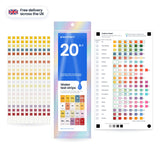
A company figure describes your area. To see what your own kitchen tap gives, a 20-in-1 strip from the WaterKit Water Test Kit shows a hardness band in 30 to 60 seconds, and we come back to that at the end.
Which water company do I look up?
The one that supplies your postcode, which is not always the obvious one. Severn Trent's checker says a postcode may not be found because another company supplies it, and gives South Staffs Water as an example. Southern Water's lookup has a message for postcodes it does not supply. The Water UK home page has a "Find your supplier" quick link, where you enter your postcode to see who provides your water and wastewater services.
The Drinking Water Inspectorate (DWI) hardness page has a map of typical hardness in England and Wales. It says to ask your water company directly for an accurate measurement, because some areas have local variation the map does not show. The page offers no postcode lookup of its own.
Where do I find the hardness figure?
On your company's own pages. These are the ones we read on 29 October 2026.
- United Utilities has a water quality search where you enter your postcode.
- Severn Trent's checker says its table shows typical values for your area, and offers a downloadable PDF report.
- Southern Water's checker takes a postcode, lets you pick the unit and offers a full water quality report.
- South East Water has a hardness search, and My Account customers can see hardness for their property.
- Yorkshire Water says it can provide detailed hardness information for your area on request.
We do not link to Anglian Water, Essex and Suffolk Water, Thames Water or SES Water, so search for their water quality pages by name. For Wessex Water, Affinity Water and Portsmouth Water we link to the home page only, so start at wessexwater.co.uk, affinitywater.co.uk or portsmouthwater.co.uk and look under water quality. We have not read those lookups.
Which unit is my figure in, and how do I convert it?
Usually mg/l of calcium carbonate (CaCO3), which United Utilities' 2025 factsheet says is the same as parts per million. It adds that you may also see Clark, French or German degrees, or mg/l as calcium. Southern Water's lookup lets you switch between all five. If yours is in another unit, multiply by the figure below. These multipliers are our arithmetic, turned round from the factsheet's conversion factors (0.4, 0.07, 0.1 and 0.056).
| If your figure is in | Multiply by | To get mg/l CaCO3 |
|---|---|---|
| mg/l as calcium (mg Ca/l) | 2.5 | mg/l CaCO3 |
| Degrees Clark (English) | 14.3 | mg/l CaCO3 |
| French degrees | 10 | mg/l CaCO3 |
| German degrees | 17.9 | mg/l CaCO3 |
Which band is my figure in?
The DWI groups hardness into five bands in mg/l of calcium carbonate.
| DWI band | mg/l calcium carbonate |
|---|---|
| Soft | Up to 100 |
| Slightly hard | 100 to 150 |
| Moderately hard | 150 to 200 |
| Hard | 200 to 300 |
| Very hard | More than 300 |
Companies label them differently. United Utilities splits the DWI's soft band at 50 mg/l into soft and moderately soft, and says there are no universally agreed criteria for hard or soft water. Southern Water calls 100 to 200 mg/l moderately hard. So the word on a lookup may not match the band your figure falls in, and the number is the part to trust.
The DWI says UK drinking water regulations specify no standards for hardness, calcium or magnesium, so there is nothing to pass or fail. It does say hard water causes scaling in hot water systems, kettles, electric irons and appliances, which shortens the life of heating elements and makes appliances less efficient. Citing the WHO 2017 guidelines, it says water at 200 mg/l or higher will produce scale. Our kettle limescale guide covers the kettle, how hard is my water goes further on reading the number, and our guide to the hardest tap water in the UK ranks the hardest places we found.
What one reader found
A home brewer posting on a forum pasted in their Anglian Water area report for January to September 2025 to work out their brewing water. It says "Your drinking water supply is classified as hard." The same hardness appears in six units, including 68.62 mg/l as calcium and 171.55 mg/l as calcium carbonate. Multiplying 68.62 by 2.5 gives 171.55, so the factor in our table matches the company's own figures. On the DWI's bands, 171.55 mg/l falls in moderately hard, which is our reading, so the company's word and the DWI's band differ for the same number.
Shared on Brewer's Friend forum.
Why might the figure on the screen not match my tap?
The area figure is a typical value for your area. Your tap can differ from it, for reasons the DWI and Severn Trent give. The DWI's map shows typical hardness and warns of local variation it does not capture. Severn Trent's table says individual results may vary slightly because of natural changes in the raw water and changes within the domestic plumbing system. If a water softener is fitted, the DWI says the common ion-exchange type replaces calcium and magnesium ions with sodium ions, so a tap downstream of it will not give the company figure. A figure for the area does not tell you what comes out of your own tap.
“The area figure is a typical value for where you live, so I would treat it as a starting point rather than a reading from your own tap. Things like local variation, your plumbing or a softener can change what actually comes out, so a quick check at the tap is sensible.”
Nobody else's postcode result sets what your kettle and boiler see. A strip indicates the band at your tap, and our guide to testing water hardness at home walks through it.
How do I check the hardness at my own tap?
Fill a clean glass or cup from the cold tap, dip one strip, wait 30 to 60 seconds and match the hardness pad to the chart in the pack. Or scan the QR code on the chart, or go to the results checker, and enter the colours. The report opens in your browser with no app or account. The pad has steps at 0, 25, 50, 100, 250 and 425 mg/l, so it indicates a band rather than a figure to the milligram. The same strip has pads for chlorine, pH, copper, nitrate and more.
A few limits to know first. The hardness pad's unit basis is unconfirmed, so setting a reading beside the DWI bands is our reading and a rough comparison. A strip is not a lab analysis or a legal sample, so use the company figure as the reference for your area and the strip to see whether your tap sits in the same band. If you have a softener, test the unsoftened kitchen drinking tap and a softened tap separately, as the DWI says the kitchen tap used for drinking and cooking should not be softened.
The area figure is a typical value, in effect an average for your area, and the DWI's map warns of local variation while Severn Trent says results vary with changes within domestic plumbing, so your tap may differ. The pad that matters here is the hardness pad. If it lands in a different band from your company's figure, that indicates your tap differs from the area value, through local variation, your plumbing or a softener. Best pack: 20 strips, enough to test your kitchen tap, a bathroom tap and a repeat test a few weeks later, £5.99 (or £10.99 with a bacteria test), with free 2nd Class delivery on every order. See the kit
Water hardness by postcode: the questions people ask
Is there one place to look up water hardness by postcode?
In the pages we read, no. The DWI offers a map of typical hardness and tells you to ask your water company for an accurate figure. Water UK's "Find your supplier" names your company, and the company's own lookup gives the hardness.
Why is my figure a range?
We found no company in the pages we read explaining ranges specifically. Severn Trent says its figures are typical values, and that individual results can vary with natural changes in the raw water and within the domestic plumbing.
Why does my neighbour's figure differ from mine?
Possibly a different company, or local variation. Severn Trent's checker says a postcode may be supplied by another company, such as South Staffs Water. The DWI says hardness varies with local geology and that areas have local variation its map does not show.
Is hard water bad for you?
The DWI says UK drinking water regulations set no standards for hardness, calcium or magnesium. What it describes is scaling in kettles, hot water systems and appliances, and less lather from soap. Our is hard water bad for you guide covers what the official sources say.
Which is more accurate, the company figure or a strip?
They answer different questions. The company figure is the reference number for your area, and Yorkshire Water's page says it does not investigate or collect samples for hardness, so it is worth asking how your company's figure is produced. A strip indicates the band at your own tap on the day you test, in steps rather than a precise figure.
Sources
- Drinking Water Inspectorate, Water Hardness / Hard Water (undated page; the five bands, no standard for hardness, the typical hardness map and advice to ask your water company, scaling effects, the WHO 2017 reference, ion-exchange softening; read 29 October 2026).
- United Utilities, water hardness factsheet 2025 (conversion factors, the six bands, no universally agreed criteria; read 29 October 2026) and Water quality (undated postcode search page; read 29 October 2026).
- Severn Trent, Check my water quality (undated page; postcodes supplied by another company, typical values, variation within domestic plumbing; read 29 October 2026).
- Yorkshire Water, Check your water hardness (undated page; hardness information on request, does not collect samples for hardness; read 29 October 2026).
- Southern Water, How hard is my water? (undated page; postcode lookup, five unit options, its own hardness bands; read 29 October 2026).
- South East Water, Water hardness (undated page; hardness search and My Account; read 29 October 2026).
- Water UK, home page ("Find your supplier" quick link; read 29 October 2026).
- Brewer's Friend forum, Tap water additions (a member's post pasting an Anglian Water area report for January to September 2025; read 29 October 2026). Anglian Water asks for written permission before anyone links to it, so its pages are named, not linked.
- WaterKit, Water Test Kit (20-in-1 strip, 30 to 60 second read, free 2nd Class delivery on every order) and results checker. The hardness pad steps, the unit comments and the reading against the DWI bands are WaterKit's own.
Contains public sector information licensed under the Open Government Licence v3.0.