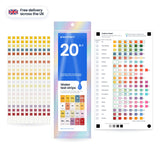


Water Test Kit
Water Test Kit
20-in-1 test strips in a resealable pouch, with every reading explained online
£12.99 Free 2nd Class delivery
- 20 readings on one strip, including hardness, chlorine, pH, nitrate and copper
- Add a coliform bacteria test to any pack for £5
- Your online report explains each reading against the UK limit where one exists, and what to do next
Choose your pack
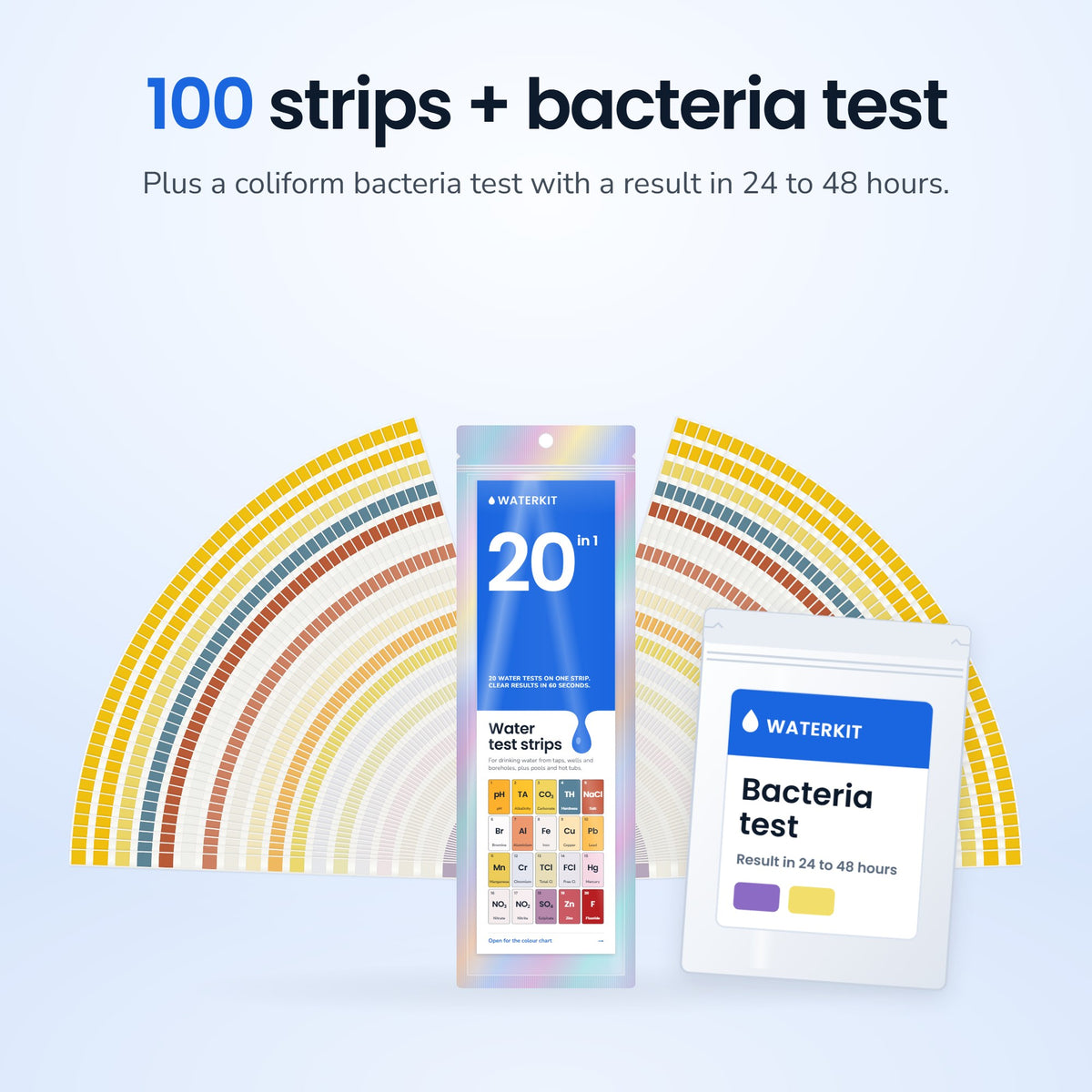
In the pack: 100 test strips · Resealable pouch · Fold-out colour chart · Online results report
Couldn't load pickup availability
- 30-day money-back guarantee · Learn more
How accurate are the strips?
Strips use colour-match chemistry and give a colour band, not a number. Each pad is matched to the nearest printed colour, so a reading sits in a range rather than at an exact figure, and right next to a limit it cannot say under or over. That is what the results portal is for: it explains every reading against the UK limit where one exists and tells you when a reading is worth confirming with a laboratory test or your water supplier.
What's in the pack
- Your chosen number of 20-in-1 test strips
- Resealable zip pouch
- Fold-out colour chart with the steps on the back
- Rapid coliform bacteria test (bacteria packs only)
- Online results portal at waterkit.co.uk/results
How to test your water
- Fill a clean glass with the water you want to test
- Dip one strip for 2 seconds, then shake off the excess
- Wait about 30 seconds, then compare each pad against the chart
- Scan the QR code for an explanation of what your readings mean
Need more help? See our full guide here.
Delivery information
How much is delivery?
| Service | Delivery | Usually arrives |
|---|---|---|
| Royal Mail 2nd Class | FREE | 2 to 3 working days |
| Royal Mail Tracked 24 | £3.99 | Next working day |
Every order gets free Royal Mail 2nd Class delivery. If you need it sooner, choose next-day Tracked 24 at checkout.
When will my order arrive?
- Order Monday to Friday before 5PM and we post it the same day.
- Order on Saturday before 10:30AM and we post it the same morning.
- Royal Mail aims to deliver 2nd Class within 2 to 3 working days, and Tracked 24 the next working day.
- Orders after these times, on Sundays or on bank holidays are posted on the next posting day. Some remote postcodes, including parts of the Scottish Highlands and islands, can take a little longer.
Can I track my order?
Tracked 24 orders are tracked to your door, and we email your tracking number as soon as your order is posted. Free 2nd Class orders fit through your letterbox and are not tracked.
Where do you deliver?
We deliver to UK addresses in England, Scotland, Wales and Northern Ireland.
Returns policy
Can I return my kit?
Yes. If your kit is unused and still in its original packaging, you can return it within 30 days of receiving it for a full refund.
How do I start a return?
Email info@waterkit.co.uk with your order number and we'll tell you where to send it. We can't accept returns sent without contacting us first.
When will I get my refund?
Once we've received and checked your kit, we'll refund your original payment method within 10 working days.
What if my kit arrives damaged or wrong?
Email us straight away with your order number and a photo, and we'll put it right.


Questions about your water?
Type a question below to find answers from our guides.
Two litres from the tap cost under a penny. From a bottle, about 80p. So is the bottle really the better bet?
If your water comes from the mains, the numbers are firmly on the tap's side. In 2025, 99.97% of nearly 3.7 million tests on England's tap water met the legal standards, and Wales matched it. When something does go wrong, it's often inside the home, such as old pipes or a loft tank. The water company's job ends at your property boundary, and the pipes after that are yours.
| Tests in England, 2025 | Met the standard |
|---|---|
| Bacteria | 99.98% |
| Chemicals, including metals and nitrate | 99.95% |
| Indicators, such as taste, colour and smell | 99.97% |
| All tests | 99.97% |
Source: Drinking Water Inspectorate, Drinking Water 2025 reports for England and for Wales.
How to check yours
National figures can't see your own pipes. Test the kitchen tap against the bathroom tap, or first thing in the morning against after a run. One strip gives 20 readings in 60 seconds, and the results checker sets each one against the UK standard where there is one.
From our guide by Andrew Tomlinson
Your kettle has a crust and the shower screen never looks clean. Is that just life in a hard water area, or something you can sort out?
It depends on where you live. Hardness is the calcium and magnesium your water picks up as rain soaks through rock. Chalk-fed supplies in the south and east of England are mostly hard, over 200 mg/l. Reservoir water in Scotland, the North West and the South West is mostly soft, under 100 mg/l. There's no UK health standard for hardness, so this one's about your kettle.
| Hardness (mg/l) | What you'll notice |
|---|---|
| Up to 100, soft | Soap lathers easily, little or no scale |
| 100 to 200, slightly to moderately hard | Some kettle furring over the months |
| 200 to 300, hard | Regular scale, and a chalky taste some people notice |
| Over 300, very hard | Heavy scale and constant descaling |
Bands from the Drinking Water Inspectorate, with slightly and moderately hard combined. What you'll notice is our summary.
How to check yours
Your water company's postcode lookup gives the typical figure for your area. A strip tells you what's coming out of your own tap in 60 seconds, and the results checker shows which band you're in. Got a softener? Test before and after.
From our guide by Andrew Tomlinson
Limescale on the kettle, or a swimming-pool taste in your glass? Find out which problem you have before you spend up to £1,500 fixing it.
For your health, probably neither. In 2025, 99.97% of England's tap water tests met the legal standards, and the Drinking Water Inspectorate says there's no need for extra treatment at home to protect your health. So it comes down to which problem you have.
| Filter jug | Water softener | |
|---|---|---|
| What it's for | Taste and smell, mainly chlorine | Limescale in hard water |
| Cost | A few pounds a cartridge, every four weeks | About £300 to £1,500, plus salt |
| Drink it? | Yes, kept in the fridge and used within a day | Keep an unsoftened kitchen tap for drinking |
| Worth pricing up when | The chlorine taste bothers you | Your hardness is 200 mg/l or more |
Costs from Which?, cartridge timing from Brita. The last row is our view.
How to check yours
Test hardness and chlorine before you buy anything. A high hardness reading points to a softener, a chlorine taste points to a jug, and if both are low you may not need either. Test again afterwards to see whether it's working.
From our guide by Andrew Tomlinson
From £3.99 for 10 strips
Strips use colour-match chemistry and give a colour band, not a number. Each pad is matched to the nearest printed colour, so a reading sits in a range rather than at an exact figure, and right next to a limit it cannot say under or over. That is what the results portal is for: it explains every reading against the UK limit where one exists and tells you when a reading is worth confirming with a laboratory test or your water supplier.
They do different jobs. A laboratory test gives measured figures, usually for 10 to 35 readings depending on the panel. A postal test that covers bacteria and chemistry costs about £180 to £365, and results usually take 10 to 14 working days once the lab has your sample. WaterKit gives you 20 banded readings in 60 seconds from £3.99 (£8.99 with a bacteria test), and the portal tells you when a reading is worth confirming with a lab. Most people use the strips first and only pay for a laboratory test when there is something to chase.
Test strips do not detect bacteria, so your kit includes a separate coliform test. Coliforms are the sign that something from the environment is getting into the water.
- Test reads
- Negative or positive
- Normal range
- Negative
- UK standard
- No coliform bacteria in 100 ml
Add 2 ml of your sample to the pouch, seal it and lay it flat. Read after 48 hours at room temperature, or 24 hours at 37°C.
Any pack size can come with a bacteria test for £5 more. Tick Add a bacteria test when you choose your pack.
Your chosen number of 20-in-1 test strips in a resealable pouch, the fold-out colour chart with the steps on the back, and access to the online results portal. Bacteria packs also include a rapid coliform bacteria test.
How much is delivery?
| Service | Delivery | Usually arrives |
|---|---|---|
| Royal Mail 2nd Class | FREE | 2 to 3 working days |
| Royal Mail Tracked 24 | £3.99 | Next working day |
Every order gets free Royal Mail 2nd Class delivery. If you need it sooner, choose next-day Tracked 24 at checkout.
When will my order arrive?
- Order Monday to Friday before 5PM and we post it the same day.
- Order on Saturday before 10:30AM and we post it the same morning.
- Royal Mail aims to deliver 2nd Class within 2 to 3 working days, and Tracked 24 the next working day.
- Orders after these times, on Sundays or on bank holidays are posted on the next posting day. Some remote postcodes, including parts of the Scottish Highlands and islands, can take a little longer.
Can I track my order?
Tracked 24 orders are tracked to your door, and we email your tracking number as soon as your order is posted. Free 2nd Class orders fit through your letterbox and are not tracked.
Where do you deliver?
We deliver to UK addresses in England, Scotland, Wales and Northern Ireland.
Can I return my kit?
Yes. If your kit is unused and still in its original packaging, you can return it within 30 days of receiving it for a full refund.
How do I start a return?
Email info@waterkit.co.uk with your order number and we'll tell you where to send it. We can't accept returns sent without contacting us first.
When will I get my refund?
Once we've received and checked your kit, we'll refund your original payment method within 10 working days.
What if my kit arrives damaged or wrong?
Email us straight away with your order number and a photo, and we'll put it right.
Yes. Wells, boreholes and springs are exactly where regular testing earns its keep, because no water company is checking the supply for you. The kit covers the metals, nitrate and nitrite that matter on private supplies, and the optional bacteria test screens for the risk you can't see. Any reading that concerns you can be confirmed by your council's environmental health team or a laboratory test.
Scan the QR code on your colour chart, or go to waterkit.co.uk/results. Photograph the strip on its chart, or tap the colours you matched, and the results portal explains what each reading means against the UK limit where one exists, with clear next steps. Save your results and your next test shows what changed.
10 strips covers a one-off check. 20 lets you compare two taps or test again later, and it is the pack most people choose. 30 suits checking before and after a filter or softener. 50 is for regular checks through the year, and for landlords, holiday lets and private supplies. Any pack size can come with a bacteria test for £5 more.
20 readings on one strip, plus an optional bacteria test. One 20-in-1 strip reads pH, alkalinity, carbonate, hardness, salt, bromine, aluminium, iron, copper, lead, manganese, chromium, total and free chlorine, mercury, nitrate, nitrite, sulphate, zinc and fluoride, and the optional rapid test screens for coliform bacteria. Dip a strip, wait 30 to 60 seconds and photograph it or match the pads against the colour chart.
How it works

Fill a glass
Fill a clean glass with the water you want to test.

Dip a strip
Dip one strip for 2 seconds, then shake off the excess.

Match the colours
Wait about 30 seconds, then compare against the colour chart.

Check online
Scan the QR code for an explanation of each reading.
Bacteria test (if your pack has one): add 2 ml of your sample to the sachet, seal it and lay it flat. Read the colour after 48 hours at room temperature, or 24 hours at 37°C. Purple means no coliform bacteria grew. Yellow means they did.
Every reading, explained properly
-

Your overview -

A reading, explained -

What to do first


Reading
Very hard water means heavy scaling on kettles, showers and heating elements. There's no UK drinking-water limit for hardness.
Photograph your strip on its chart, or tap the colours you matched. Your results set each reading against the UK standard where one exists, explain what it means and tell you what to do next.
- Normal, watch or action. Each reading is marked against the UK standard where one exists.
- Tap any reading. See what it is, what the strip reads and the UK standard.
- Plain-English next steps. The report tells you whether to run the tap, test again, contact your supplier or book a lab test.
- Save and share. Keep your reports on your phone, send a link to a plumber or landlord, and compare next time.
Strips give a banded reading, not a laboratory number. Your report says when a lab test is worth it.
How WaterKit compares
Strips and lab tests do different jobs. Here's where each one fits.
Start with WaterKit for regular checks. If a reading needs confirming, your results tell you when a lab test is worth it.
Choose your packOnline strips: 11 best-selling multi-parameter drinking water strip kits on Amazon.co.uk. Lab tests: published prices and turnaround times from UK postal water testing laboratories. Checked 24 October 2026.

For your skin, your tea and your home
Hardness, chlorine and minerals change how your water feels, tastes and treats your home. One strip shows you where yours sits, and the results explain what each reading means.
- Skin and hairHardness and chlorine
- Taste and colourChlorine, iron, manganese and sulphate
- Filters and softenersHardness and chlorine, before and after
- Kettle and appliancesHardness and alkalinity
- Older pipesCopper, iron and pH
- Private suppliesColiform bacteria test
Everything you need to test your water in one easy to use kit.
- 3 Chemistry
- pH, alkalinity, carbonate
- 8 Metals
- lead, copper, iron and 5 more
- 4 Salts
- nitrate, nitrite, sulphate, salt
- 2 Minerals
- hardness, fluoride
- 3 Sanitisers
- free and total chlorine, bromine
- 1 Bacteria
- coliforms, optional test

Test for 20 analytes on a single strip
Reads pH, alkalinity, hardness, chlorine, nitrate, copper and more at everyday levels. Seven pads, including lead and mercury, only pick up high levels, and a laboratory test measures those at UK limits.
-

Chemistry · pad 1
Reads at UK levels
How acidic or alkaline your water is, which affects taste and the life of your pipework.
-

Chemistry · pad 2
Reads at UK levels
The water's ability to resist swings in pH, which helps keep it stable and kind to pipework.
-

Chemistry · pad 3
Reads at UK levels
The carbonate part of alkalinity, linked to temporary hardness and how much limescale forms.
-

Minerals · pad 4
Reads at UK levels
Dissolved calcium and magnesium, which cause limescale and dry skin but pose no health risk.
-

Salts · pad 5
Reads at UK levels
Dissolved salt, which affects taste and is worth watching if you are on a low-sodium diet.
-

Sanitisers · pad 6
Reads at UK levels
A pool and spa sanitiser not used for tap water, so it should not appear in drinking water.
-

Metals · pad 7
High levels only
Sometimes left over from water treatment, and limited in the UK as it can discolour water.
-

Metals · pad 8
High levels only
Usually from corroding pipes, and the cause of rusty stains and a metallic taste.
-

Metals · pad 9
Reads at UK levels
Picked up from copper pipework, causing blue-green stains and, in excess, an upset stomach.
-

Metals · pad 10
High levels only
From old lead pipes and solder, and best kept as low as possible, especially for children.
-

Metals · pad 11
Reads at UK levels
A natural mineral in groundwater that can stain fittings and taste bitter, so UK limits apply.
-

Metals · pad 12
High levels only
An industrial contaminant, rare in UK tap water, worth confirming with a lab test if detected.
-

Sanitisers · pad 13
Reads at UK levels
Free and combined chlorine together, showing how much disinfectant is in your water overall.
-

Sanitisers · pad 14
Reads at UK levels
The active disinfectant left in the water to protect it on its way to you, which can affect taste and smell.
-

Metals · pad 15
High levels only
Rare in UK tap water and usually industrial in origin. Confirm with a lab test if detected.
-

Salts · pad 16
Reads at UK levels
Mostly from fertiliser run-off and septic systems, and important to keep low for young babies.
-

Salts · pad 17
High levels only
Formed as nitrate breaks down, and usually a sign of contamination that needs following up.
-

Salts · pad 18
Reads at UK levels
A natural mineral that at higher levels gives a bitter taste and can have a laxative effect.
-

Metals · pad 19
Reads at UK levels
From galvanised pipework, harmless at normal levels but it can leave a metallic taste.
-

Minerals · pad 20
High levels only
Natural, and added in some areas to protect teeth, though too much can mottle children's teeth.


-
If you own or use a private supply it is important that you are aware of the quality of the supply and the risks associated with it.
Drinking Water Quality Regulator for Scotland
Learn more -
Water may pick up traces of substances from your plumbing and water fittings or appliances and this situation is the most common cause of unusual or strange tastes.
Drinking Water Inspectorate
Learn more -
There are lots of reasons why the taste or smell of your tap water might change.
GOV.UK
Learn more
Watch WaterKit in action
We're here to help
Email us about anything to do with testing your water, including:
- Understanding your results
- Testing a private supply
- Orders and delivery
How accurate are test strips?
Strips use colour-match chemistry and give a colour band, not a number. Each pad is matched to the nearest printed colour, so a reading sits in a range rather than at an exact figure, and right next to a limit it cannot say under or over. That is what the results portal is for: it explains every reading against the UK limit where one exists and tells you when a reading is worth confirming with a laboratory test or your water supplier.
Is this as good as a lab test?
They do different jobs. A laboratory test gives measured figures, usually for 10 to 35 readings depending on the panel. A postal test that covers bacteria and chemistry costs about £180 to £365, and results usually take 10 to 14 working days once the lab has your sample. WaterKit gives you 20 banded readings in 60 seconds from £3.99 (£8.99 with a bacteria test), and the portal tells you when a reading is worth confirming with a lab. Most people use the strips first and only pay for a laboratory test when there is something to chase.
Which size do I need?
10 strips covers a one-off check. 20 lets you compare two taps or test again later, and it is the pack most people choose. 30 suits checking before and after a filter or softener. 50 is for regular checks through the year, and for landlords, holiday lets and private supplies. Any pack size can come with a bacteria test for £5 more.
What happens if a reading is out of range?
The portal shows the reading in amber or red, explains what it usually means and gives the next step: re-test with a fresh sample, run the tap, contact your water supplier or your council's environmental health team on a private supply. For any reading outside its normal range we can also arrange a UKAS-accredited laboratory test of your water.
Do I need an app or an account?
No. Scan the QR code on your chart and your report opens in your browser.
Are my results private?
Your readings are saved in your browser on this device, and there's no account to create. The web address of your report contains the readings, so anyone you send the link to can see them. Only share it with people you choose.
Does it work on a private water supply?
Yes. Wells, boreholes and springs are exactly where regular testing earns its keep, because no water company is checking the supply for you. The kit covers the metals, nitrate and nitrite that matter on private supplies, and the optional bacteria test screens for the risk you can't see. Any reading that concerns you can be confirmed by your council's environmental health team or a laboratory test.
How often should I test my water?
Little and often. Drinking supplies roughly once a month, straight away after plumbing work or moving in, and any time the taste, smell or look changes. A strip takes a minute, so testing often is easy.
Ready to test your water?
20 readings on one strip, an optional bacteria test and a report that explains each reading against the UK limit where one exists.
30-day money-back guarantee · Free 2nd Class delivery on every order