

Why does my kettle get limescale?
Share
Part of our hard water guide
The crust is predictable, but how fast it builds depends on your own tap, and a WaterKit 20-in-1 strip can give you a hardness band for that tap in about a minute.
Short answer: Kettle scale is calcium carbonate that was dissolved in your tap water and came out of solution when it boiled. The Drinking Water Inspectorate says hardness comes from dissolved calcium and magnesium, and cites the World Health Organization view that water at 200 mg/l or more as calcium carbonate will produce scale.
By Andrew Tomlinson, WaterKit · Last reviewed 29 October 2026
What is the crust inside my kettle made of?
It is calcium carbonate, left behind when hard water is boiled. The Drinking Water Inspectorate (DWI) says water hardness is caused by dissolved calcium and magnesium, and that it varies with local geology. Our limescale guide covers the deposit itself.
A United Utilities factsheet says rain is naturally soft, and that hard water forms when water passes through or over limestone or chalk and picks up calcium and magnesium. It splits hardness into two parts.
- Temporary (carbonate) hardness. United Utilities says boiling can form calcium carbonate scale that deposits on things like kettle elements. The DWI describes the same part as calcium and magnesium carbonates and bicarbonates, which boiling removes as scale.
- Permanent (non-carbonate) hardness. United Utilities says this is calcium and magnesium sulphate, and that it does not go on to form scale when heated or boiled.
In our reading, that means two taps with the same total hardness could scale a kettle at different rates. The DWI says scale shortens the life of heating elements and makes appliances less efficient. Hard water also gives less lather, leaves tide marks on basins and baths, and leaves a scum on hot drinks, especially tea brewed in the cup. United Utilities adds that scale will not stick to a kettle with a plastic polypropylene lining but will float on the surface.
How hard is hard?
Hardness is quoted in mg/l of calcium carbonate. United Utilities uses six bands in its 2025 factsheet and notes that there are no universally agreed criteria for hard or soft water. The DWI's own table is coarser, with soft at up to 100 mg/l and hard from 200 to 300 mg/l.
| Band (United Utilities) | mg/l calcium carbonate | What a kettle does (our description) |
|---|---|---|
| Soft | 0 to 50 | Stays clean for months or longer. |
| Moderately soft | 51 to 100 | A faint film over a few months. |
| Slightly hard | 101 to 150 | A visible film that needs descaling now and then. |
| Moderately hard | 151 to 200 | Regular scale. At 200 and above the WHO view, as quoted by the DWI, is that water will produce scale. |
| Hard | 201 to 300 | Thick scale builds quickly in a kettle used all day. |
| Very hard | over 300 | Scale on everything that heats water. |
The DWI says UK drinking water regulations set no standard for hardness, calcium or magnesium. United Utilities says none of the North West supply is artificially softened by the company. To see where your postcode sits, use our postcode hardness guide.
Why might my kettle scale differently from the area figure?
The sources we read give several reasons.
- Local variation. The DWI says its map shows typical hardness across England and Wales, and that some areas vary locally in ways the map does not show.
- The carbonate share. Only the temporary part forms kettle scale, so total hardness alone does not say how fast your element crusts up.
- A softener in the house. The DWI says a softener fitted just before the hot water tank or boiler is a more economical way to prevent scale than softening the whole supply, and that the kitchen drinking tap should stay unsoftened.
- A recent move. United Utilities says people who move between hard and soft areas may notice a difference in taste, especially in tea, or in limescale.
“The area figure is only an average, so I would always check your own tap before assuming your kettle should behave the way the postcode says. A softener in the house, a different mix of hardness types or just local variation can all make your water scale differently from your neighbour's.”
What one reader found
One Mumsnet poster in February 2025, in a thread titled as a hard water area, wrote that "The limescale build up in my kettle is becoming a nightmare." Their kettle was years old, they drank 5 to 6 cups of tea a day, and repeated descaling now made barely any difference. They concluded it was time to give up on that kettle and ask for recommendations for a replacement.
It shows how a daily-use kettle in hard water can reach the point where descaling stops helping. It does not tell us the poster's hardness figure, and we do not suggest they used WaterKit. Shared on Mumsnet.
What can a hardness strip show at my own tap?
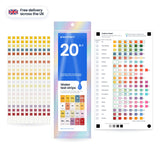
It indicates a hardness band. The WaterKit Water Test Kit has a hardness pad on its 20-in-1 strip. Fill a clean glass or cup from the cold tap, dip one strip, wait 30 to 60 seconds and match the pad to the chart. The pad reads in steps, so you get a band rather than an exact figure. The swatches below approximate the printed chart, and the chart in the pack is the one to match. Our guide to testing water hardness at home walks through it.
| Pad colour | Chart step | Band on the results portal |
|---|---|---|
| 0 mg/l | Soft | |
| 25 mg/l | Soft | |
| 50 mg/l | Soft | |
| 100 mg/l | Moderately soft | |
| 250 mg/l | Hard | |
| 425 mg/l | Very hard |
You can enter the colour in the results portal, or scan the QR code on the chart, and no app or account is needed. The portal's bands are WaterKit's own groupings of the chart steps, and the chart has no step between 100 and 250. We do not know whether the pad's unit basis is calcium carbonate, so setting it beside the bands above is our reading, and your water company's zone figure remains the reference number.
The strip gives total hardness only. It cannot split temporary from permanent hardness, so it cannot say how much will actually scale a kettle. A reading is not a legal sample, and we do not claim the test for measuring limescale already in your pipes or boiler.
The area figure is an average, and the DWI says some areas vary locally in ways its map does not show, so your own tap may read differently. The pad that matters here is hardness. A band that differs between the kitchen cold tap and the hot tap, or that shifts after a softener or filter jug change, would point to local variation or softening rather than the area figure. Best pack: 20 strips, enough to test the kitchen cold tap, the hot tap and a second visit after any filter or softener change, £5.99 (or £10.99 with a bacteria test), with free 2nd Class delivery on every order. See the kit
Kettle limescale: the questions people ask
Why does my kettle get limescale?
Boiling turns the carbonate part of the dissolved calcium and magnesium in your tap water into solid calcium carbonate on the element and walls.
Is limescale in a kettle bad for you?
We found no statement from the DWI or United Utilities in the pages we read that rates kettle scale as a health matter. Our is limescale bad for you guide goes further. The DWI's one caution is about softened water, which can carry extra sodium that it says can matter for premature babies and for people on a low-sodium diet.
Does soft water never scale a kettle?
The sources we read do not say that. United Utilities adds that soft water of 100 mg/l or less can be more corrosive to pipes.
Does a filter jug stop limescale?
Only some do, and only partly. The DWI says some activated carbon jug filters contain ion exchange resin that changes temporary hardness, so tea forms less scum and kettles may scale less, but they do not alter permanent hardness. Our filter jug guide covers the rest.
What is the quickest way to find my hardness?
The DWI says to ask your water company directly for an accurate figure. A strip gives you the band at your own tap, and how hard is my water explains both routes.
Sources
- Drinking Water Inspectorate, Water Hardness / Hard Water (hardness bands, scaling effects, no standard for hardness, WHO 200 mg/l scale value, temporary hardness and boiling, jug filters, softeners and sodium; undated page; read 29 October 2026).
- United Utilities, Water hardness factsheet (document code ends 09/25; limestone and chalk, temporary and permanent hardness, polypropylene linings, the six bands, no softening by United Utilities in the North West, jug filters; undated; read 29 October 2026).
- Mumsnet, Kettle Recommendations for a Hard Water Area (original post dated 17 February 2025; read 29 October 2026).
- WaterKit, Water Test Kit and results portal (20-in-1 strip, hardness pad steps 0, 25, 50, 100, 250 and 425 and the portal's bands). The strip comments and the kettle column in our table are WaterKit's own reading.
Contains public sector information licensed under the Open Government Licence v3.0.