

What are the WHO drinking water guidelines, and how do UK standards compare?
Share
Part of our tap water guide
A WHO number and a UK number can look alike on paper, yet only one of them is law. Here is where they match, where they part ways, and who checks your tap.
Short answer: WHO's Guidelines for drinking-water quality give guideline values that governments use as a starting point, and are not legal limits. UK law sets its own standards, mostly at the consumer's tap. Many match, including nitrate at 50 mg/l, copper at 2 mg/l and fluoride at 1.5 mg/l, while some differ, such as nitrite at 0.5 mg/l against WHO's 3 mg/l.
By Andrew Tomlinson, WaterKit · Last reviewed 25 October 2026
What are the WHO drinking water guidelines?
They are the World Health Organization's (WHO) international reference on drinking-water quality, and they are advice rather than law. The current text is the fourth edition incorporating the first, second and third addenda, published on 17 June 2026, which WHO's summary note says supersedes the 2022 edition. Its list of key updates includes no change to the chemical values below, which we read from the 2026 text.
The Guidelines cover microbial, chemical, radiological and acceptability (taste, odour and appearance) aspects. WHO says a chemical guideline value normally marks a concentration that carries no significant health risk over a lifetime of drinking the water, and some values are marked provisional, for example where the calculated value is below what treatment can achieve. WHO calls the Guidelines a "scientific point of departure for national authorities" writing their own regulations, and explains why it does not promote the adoption of international standards.
Are WHO guidelines legal limits in the UK?
No. UK drinking water law sits in each nation's own regulations. In England it is the Water Supply (Water Quality) Regulations 2016, which apply to water companies in England. Wales has its 2018 Regulations, Scotland the Public Water Supplies (Scotland) Regulations 2014 (as amended) and Northern Ireland its 2017 Regulations. Private supplies fall under separate rules, which our well and borehole guide covers.
The Drinking Water Inspectorate (DWI) says the UK's legal standards were based on those in the 1998 EU Drinking Water Directive and later revisions, plus national standards, and that the expert evidence behind health-based standards is documented in the WHO Guidelines. So the two overlap heavily, but only the UK figures are legal duties on water companies.
In England the standards come in tiers. Schedule 1 lists the prescribed values for wholesomeness, including "national requirements" such as iron, manganese, aluminium and sodium. Schedule 2 lists indicator parameters, such as pH and chloride, which a company must investigate when they are not met (regulation 19).
How is water quality managed in the UK?
Water companies treat and sample the water, and independent regulators check them. The DWI regulates public supplies in England and Wales through compliance data, water quality events, consumer complaints and company audits. The Drinking Water Quality Regulator monitors Scottish Water's samples and can serve enforcement notices. In Northern Ireland the Drinking Water Inspectorate, a business unit within the Northern Ireland Environment Agency, regulates drinking water quality. The England Regulations require a company to disinfect water before supplying it (regulation 26).
How do WHO guideline values compare with UK standards?
Five substances in the table have the same number in both, and three have a lower UK figure. The table sets WHO's 2026 text beside the England Regulations, and for parameters that have a figure the Welsh, Scottish and Northern Ireland Regulations list the same numbers. The right-hand column is WaterKit's own reading of our strip chart, not a legal comparison. The Regulations use micrograms per litre (µg/l) where WHO uses milligrams (1 mg/l is 1,000 µg/l).
| Parameter | WHO guideline value | UK legal figure | WaterKit strip chart (our reading) |
|---|---|---|---|
| Nitrate | 50 mg/l as nitrate | 50 mg/l (Schedule 1) | A step at 50 mg/L, with steps at 25 and 100 mg/L either side |
| Nitrite | 3 mg/l as nitrite | 0.50 mg/l at the tap, 0.10 mg/l leaving the treatment works (Schedule 1) | First step 1 mg/L, above the UK figure and below WHO's. A zero means none detected at that step |
| Copper | 2 mg/l | 2.0 mg/l (Schedule 1) | A step at 2 mg/L, with steps at 1 and 5 mg/L either side |
| Lead | 0.01 mg/l (10 µg/l), provisional | 10 µg/l (Schedule 1) | First step 20 mg/L on our chart, above both figures |
| Fluoride | 1.5 mg/l | 1.5 mg/l (Schedule 1) | First step 4 mg/L, above the figure |
| Chromium | 0.05 mg/l as total chromium | 50 µg/l (Schedule 1) | First step 2 mg/L, far above both figures |
| Mercury | 0.006 mg/l as inorganic mercury | 1.0 µg/l (Schedule 1) | First step 0.5 mg/L, far above both figures |
| Manganese | 0.08 mg/l as total manganese, provisional | 50 µg/l, which is 0.05 mg/l (Schedule 1, national requirement) | A step at 0.05 mg/L, the UK figure, and WHO's 0.08 falls between the 0.05 and 0.1 steps |
| Iron | No guideline value. WHO says iron stains laundry and fixtures above about 0.3 mg/l | 200 µg/l, which is 0.2 mg/l (Schedule 1, national requirement) | First step 1 mg/L, above the UK figure |
| Aluminium | No guideline value. WHO cites practicable treatment levels of 0.1 to 0.2 mg/l | 200 µg/l, which is 0.2 mg/l (Schedule 1, national requirement) | First step 5 mg/L, far above the UK figure |
| Free chlorine | 5 mg/l | No chlorine figure in Schedule 1 or 2. Regulation 26 requires disinfection | Steps at 3, 5 and 10 mg/L on the free chlorine pad, so 5 sits on a step |
| pH | No health-based value. WHO says the optimum is usually 6.5 to 8.5 | 6.5 to 9.5, an indicator parameter (Schedule 2) | Six steps from 6.2 to 8.4. See our pH guide |
| Hardness and zinc | No health-based value | No figure in Schedule 1 or 2 | Hardness steps 25 to 425 mg/L, zinc 5 to 100 mg/L, with no figure to compare |
| Sodium and chloride | No health-based value. WHO gives an average taste threshold of about 200 mg/l for sodium and says chloride above 250 mg/l is increasingly likely to be tasted | Sodium 200 mg/l (Schedule 1, national requirement), chloride 250 mg/l (Schedule 2, at the supply point) | A sodium chloride pad with steps from 100 to 2000 mg/L, which is not a direct reading of either figure |
- Nitrate and nitrite. Regulation 4(2)(d) of the England Regulations also applies a combined test in which nitrate divided by 50 plus nitrite divided by 3 must not exceed 1. WHO describes the same sum-of-ratios test.
- Lead. The numbers match, but WHO says its 10 µg/l is provisional and no longer a health-based value, and that levels should be kept as low as reasonably practical. See our lead pipes guide.
- Chlorine. The DWI says companies typically keep the residual to 0.5 mg/l or less, and that WHO has set a health-based guideline maximum of 5 mg/l. See our chlorine guide.
How good is the UK's water quality?
The regulators report compliance of 99.88% to 99.97%, each on its own basis. For England the DWI reports that supplies complied in 99.97% of tests in 2025, across about 3.6 million compliance tests (3,608,411 in Annex A), with 24 water companies serving 59.74 million consumers. It records 982 failures, 447 of them related to consumers' own distribution systems. Wales is also 99.97% overall. Scotland's regulator reports 99.88% of 137,947 consumer tap tests complying in 2025, and Northern Ireland's DWI reports 99.88% overall for the mains supply in 2024.
The DWI's foreword says high compliance must not lead to complacency, and the report flags the condition of tanks and service reservoirs.
Why does water quality matter, and what does the term cover?
WHO's drinking-water fact sheet (dated 13 September 2023) says the quality and availability of water matter for public health, whether it is used for drinking, domestic use, food production or recreation. The term covers what is in the water and how it looks, smells and tastes. The DWI says the UK standards cover micro-organisms, chemicals such as nitrate and pesticides, metals such as lead and copper, and the way water looks and tastes. In England, regulation 4 of the 2016 Regulations treats water as "wholesome" when it meets the prescribed values and contains nothing at a concentration that would be a potential danger to human health.
How can you compare your own water with these numbers?
Start with your water company's results for your supply zone, because those are the legal samples. The DWI advises asking your water company for a free copy of the drinking water quality report for your supply, which shows the legal standards and the maximum and minimum levels in your tap water. In England, regulation 35 says anyone may request a copy of a supply zone's record, free of charge to people supplied in that zone.
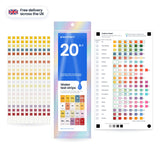
The WaterKit Water Test Kit gives a quick check at your own tap. Dip one 20-in-1 strip, wait 30 to 60 seconds and match the pads to the chart, or enter the colours in the results portal. By our reading of the table, the nitrate, copper and manganese pads have a step at the UK figure and the free chlorine pad has one at WHO's 5 mg/l, so on those pads a reading indicates which band the water falls in. On the iron, nitrite, lead, fluoride, aluminium, mercury and chromium pads the first colour step sits above the UK figure, so a zero means none detected at that step and cannot show the level is below the limit. A strip result is not a legal sample. Our home water testing guide covers sampling.
Best pack: 50 strips, enough to read the kitchen cold tap on more than one day and again after any plumbing change, £8.99 (or £13.99 with a bacteria test), with free 2nd Class delivery on every order. See the kit
Your WHO and UK water quality questions
Why is water quality important?
WHO's fact sheet says the quality and availability of water matter for public health, whether it is used for drinking, domestic use, food production or recreation.
What is water quality?
What is in the water and how it looks, smells and tastes. The DWI says the UK standards cover micro-organisms, chemicals, metals and appearance and taste.
WHO water quality standards and guidelines?
WHO publishes guidelines and not standards, and explains why it does not promote adopting international ones. National authorities use them as a starting point for their own regulations.
WHO guidelines for drinking-water quality?
The current edition is the fourth edition incorporating the first, second and third addenda, published by WHO on 17 June 2026.
WHO drinking water quality?
WHO frames it as microbial, chemical, radiological and acceptability aspects, managed through health-based targets, water safety plans and independent surveillance.
WHO water quality standards table?
The comparison table above sets WHO's guideline values beside the UK figures for the parameters our strip reads. WHO's full list is Annex 3, Table A3.3, of the Guidelines.
What is the water quality index?
The phrase means different things in different places. In our search of the DWI and gov.uk we found no UK official drinking water quality index. The DWI reports compliance percentages and risk indices, including a Compliance Risk Index that it says is not a statutory measure.
Sources
- World Health Organization, Guidelines for drinking-water quality, fourth edition incorporating the first, second and third addenda (17 June 2026, 647 pages; introduction, chapters 10 and 12, and Annex 3 Table A3.3; read 25 October 2026) and its summary of the key updates (the current version supersedes the 2022 edition; read 25 October 2026). The DWI's standards page below still links to the 2022 edition.
- World Health Organization, Drinking-water fact sheet (dated 13 September 2023, so older than the Guidelines; read 25 October 2026).
- The Water Supply (Water Quality) Regulations 2016, Schedule 1, Schedule 2, regulation 1 (application to water undertakers whose area is not wholly or mainly in Wales), regulation 4 (wholesomeness and the nitrate and nitrite formula), regulation 9 (numbers of samples), regulation 19 (indicator parameters), regulation 26 (disinfection) and regulation 35 (copies of zone records; read 25 October 2026).
- The same figures for the parameters in the table appear in the Water Supply (Water Quality) Regulations 2018 for Wales (Schedules 1 and 2), the Public Water Supplies (Scotland) Regulations 2014 (Schedule 1, Tables B and C, as amended) and the Water Supply (Water Quality) Regulations (Northern Ireland) 2017 (Schedules 1 and 2; read 25 October 2026). The nations differ on some other parameters, for example boron (1.5 mg/l in Scotland against 1.0 mg/l in England), which we did not compare.
- Drinking Water Inspectorate, Drinking Water Standards and Regulations (standards based on the 1998 Directive and national standards; WHO Guidelines document the expert evidence; national requirements apply only in England and Wales; read 25 October 2026).
- Drinking Water Inspectorate, What we do (role in England and Wales; read 25 October 2026) and Chlorine (residual typically 0.5 mg/l or less, most companies aiming below 1 mg/l, WHO guideline maximum 5 mg/l; read 25 October 2026) and Domestic water filters and softeners (free copy of the drinking water quality report; read 25 October 2026).
- Drinking Water Inspectorate, Drinking Water 2025 for England, Water supplies and testing (24 companies, 59.74 million consumers), Compliance with water quality standards (99.97% overall; Compliance Risk Index not statutory), Annex A (Table 21, 3,608,411 tests), the Foreword (high compliance must not lead to complacency) and the 7 July 2026 announcement (982 failures, 447 related to consumers' own distribution systems; asset health; read 25 October 2026).
- Drinking Water Inspectorate, Drinking Water 2025 for Wales, Compliance with standards (overall 99.97%; read 25 October 2026).
- Drinking Water Quality Regulator for Scotland, Public supplies annual report 2025 (99.88% of 137,947 consumer tap tests; read 25 October 2026) and its home page (what the regulator does).
- Department of Agriculture, Environment and Rural Affairs, Drinking Water Inspectorate publishes 2024 report (20 February 2026; 99.88% overall for the mains supply in 2024, over 100,000 tests; the Inspectorate is a business unit within the Northern Ireland Environment Agency; read 25 October 2026).
- WaterKit, Water Test Kit (20-in-1 strip, 30 to 60 second read, from £3.99, free 2nd Class delivery on every order, 30-day money-back guarantee) and results portal (colour steps for each pad). The right-hand column of the table is WaterKit's own reading of the colour chart steps.
Contains public sector information licensed under the Open Government Licence v3.0.