

What pH should drinking water be?
Share
Part of our water testing guide
The legal pH range is easy to look up and harder to apply to your own kitchen tap, which you can check with a 20-in-1 strip.
Short answer: Between 6.5 and 9.5. Schedule 2 of the Water Supply (Water Quality) Regulations 2016, which apply in England, lists pH as an indicator parameter with a minimum of 6.5 and a maximum of 9.5 at the consumer's tap. The Welsh 2018 and Scottish 2014 Regulations list the same range.
By Andrew Tomlinson, WaterKit · Last reviewed 29 October 2026
What pH should drinking water be?
Between 6.5 and 9.5 at the consumer's tap. Schedule 2 of the 2016 Regulations lists the hydrogen ion (pH) with a maximum of 9.5, a minimum of 6.5 and the consumers' taps as the point of compliance. It is an indicator parameter. Regulation 19 says a water company that has reason to believe an indicator specification is not met must immediately take the steps needed to identify the reason, and then notify the Secretary of State.
The same range appears in Schedule 2 of the Welsh 2018 Regulations and in Table C of the Scottish 2014 Regulations, both at the consumer's tap. The 2016 Regulations apply to water companies in England. We did not open the Northern Ireland Regulations for this update, so we say nothing about them here.
The range is 3 units wide, which is our own arithmetic. Two taps that both sit inside it can still read quite differently.
What is the pH of tap water, and is tap water alkaline?
The legal pages we read give a permitted range and not a typical reading, so we cannot give you one number for UK tap water. Nothing in the sources we read says whether tap water is acidic or alkaline. They say only that pH at the tap should fall between 6.5 and 9.5. For your area, ask your water company for the record of your supply zone (see below). For your own tap, the pH pad on a 20-in-1 strip gives a colour band, as explained further down.
What is the pH of pure, distilled, rain, salt or RO water?
None of the pages we read gives a figure for any of them. They are the regulations for public supplies, and they set no pH value for pure water, distilled water, rainwater or seawater. Our guides cover distilled water, reverse osmosis water and rainwater.
The Scottish regulations do say something about treated water. Table C, note 1, says water must not be aggressive or corrosive, and that this applies particularly to water undergoing demineralisation, softening, membrane treatment or reverse osmosis. Note 2 says calcium and magnesium salts could be added to such water to condition it, to reduce corrosiveness and to improve taste.
Hardness is a separate matter. Neither Schedule 1 nor Schedule 2 of the 2016 Regulations lists hardness, alkalinity or carbonate, and the pages we read do not say whether hard water is acidic or alkaline. See our hard water guide for hardness itself.
Can you raise or lower the pH of drinking water?
The sources we read give no household method, and none of the regulation pages listed below gives guidance on doing it at home. They describe the limits that water must meet and not how to adjust it. The Scottish regulations' note on treated water above is the closest they come. For a swimming pool, which is a different question, see our pool pH guide.
Why might the pH at your tap differ from the area figure?
The area figure is an average. A record for your supply zone is not a reading taken from your own kitchen tap. The regulations set pH at consumers' taps, but a figure for the area does not tell you what comes out of your own tap.
The regulations recognise that plumbing inside a property matters. For coliform bacteria and colony counts, regulation 19(1)(c) asks the water company to work out whether a failure is attributable to the domestic distribution system, to its maintenance or to neither, and regulation 19(3) says the company must tell affected consumers when it is. That provision is not about pH, so we are not saying plumbing changes pH. We are saying the law itself treats the pipes inside a home as a separate part of the picture.
“I would treat the area figure as a starting point, because it is an average and your tap sits at the end of pipework the water company's record does not describe. A quick check at your own kitchen tap gives you a colour band from your own water rather than a figure for the whole zone.”
You can ask for the official record. Regulation 35 says anyone can ask a relevant supplier for a copy of a record it keeps, which it must send within 7 days. It is free for a request about a water supply zone if you are supplied in that zone. The regulation applies in England. The record shows the zone, and it still cannot show your own tap on a given Tuesday morning.
How can you check the pH of your own tap water?
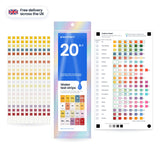
Use a strip, then compare the colour with the chart. The WaterKit Water Test Kit has a pH pad among its 20 readings. Fill a clean glass or cup from the tap, dip one strip, wait 30 to 60 seconds and match the pad to the chart, or enter the colours in the results portal. No app or account is needed. The pad has six colour steps, and this table sets them against the 6.5 to 9.5 range. It is our own reading of the chart steps.
| pH chart step | Where the step's own value sits against 6.5 to 9.5 (our reading) |
|---|---|
| 6.2 | Below the 6.5 minimum |
| 6.8 | Inside the range |
| 7.2 | Inside the range |
| 7.6 | Inside the range |
| 7.8 | Inside the range |
| 8.4 | Inside the range. It is the top step, so the chart cannot show a pH above it |
A colour between the 6.2 and 6.8 steps spans the 6.5 minimum, so the chart cannot show which side of it the water sits on. The chart stops at 8.4, so it cannot show whether a reading is above 9.5. The steps are 0.2 to 0.6 apart, so a strip indicates a band and not a decimal. Re-test with a fresh strip and a fresh sample before reading anything into a surprising colour.
Two neighbouring pads add context. Total alkalinity has steps at 0, 40, 80, 120, 180 and 240 mg/L, and carbonate at 0, 40, 80, 120, 180 and 300 mg/L. We found no alkalinity or carbonate value in Schedule 1 or Schedule 2, so there is no legal number to compare them with. A strip result is not a legal sample. Our home water testing guide covers sampling.
The area figure is an average, and a record for your supply zone is not a reading from your own kitchen tap, where the law itself treats the pipes inside a home as a separate part of the picture. The pH pad is the one that matters here, and a colour that moves from one chart step to another between tests would indicate that the pH at your tap has changed, with the alkalinity and carbonate pads adding context alongside it. Best pack: 20 strips, enough to read pH at the kitchen cold tap on different days and again after any plumbing change or new filter, £5.99 (or £10.99 with a bacteria test), with free 2nd Class delivery on every order. See the kit
Your water pH questions
What is the pH of water?
The pages we read give no single figure. The regulations list 6.5 to 9.5 at the consumer's tap for drinking water.
What is the pH of pure water?
None of the pages we read gives one. They cover drinking water supplies, with a range of 6.5 to 9.5.
What pH does distilled water have?
The sources we read give no figure. Our distilled water guide explains what distilled means.
What is the pH of tap water?
The regulations for England, Wales and Scotland specify 6.5 to 9.5 at the consumer's tap, as an indicator parameter. For your own area, ask your water company for your supply zone's record.
Is tap water alkaline?
The pages we read do not say. They set a range of 6.5 to 9.5 and no typical value.
Is hard water acidic or alkaline?
The sources we read do not say, and none of them lists hardness as a parameter. See our hard water guide.
Is salt water alkaline?
The legislation we read does not cover seawater, so we have no figure to give.
What is the pH of rainwater?
The sources we read give no figure. Collected rainwater is covered in our rainwater guide.
What is the pH of RO water?
We found no figure in these sources. The Scottish regulations say water must not be aggressive or corrosive, particularly water undergoing reverse osmosis or other membrane treatment, and that calcium and magnesium salts could be added to condition it.
How to lower pH of water, and how to increase it?
The sources we read give no household method. They set the range that supplied water must meet, and our pool pH guide covers pools only.
How to check pH level of water?
With a strip, as above. Ours has six pH steps from 6.2 to 8.4, and you can enter the colours in the results portal.
Why does the pH of water change with temperature?
We found no explanation in the pages we read. In Schedule 2 the pH entry gives no temperature, and only conductivity (20°C) and colony counts (22°C) do.
Sources
- The Water Supply (Water Quality) Regulations 2016, Schedule 2 (indicator parameters; hydrogen ion 9.5 maximum and 6.5 minimum, pH value, consumers' taps; conductivity at 20°C and colony counts at 22°C), Schedule 1 (no hardness, alkalinity or carbonate parameter), regulation 19 (investigations for indicator parameters, domestic distribution system) and regulation 35 (copies of records, within 7 days, free for a supply zone request if supplied in the zone; all undated pages, read 29 October 2026). These apply in England.
- The Water Supply (Water Quality) Regulations 2018 (Wales), Schedule 2 (hydrogen ion 9.5 maximum, 6.5 minimum, consumers' taps; undated; read 29 October 2026).
- The Public Water Supplies (Scotland) Regulations 2014, Schedule 1 (Table C, indicator parameters as substituted from 1 January 2023; hydrogen ion 9.5 maximum, 6.5 minimum, consumer's tap; notes 1 and 2 on aggressive or corrosive water and conditioning demineralised water; undated; read 29 October 2026). We did not open the Northern Ireland Regulations for this update.
- WaterKit, Water Test Kit (20-in-1 strip, 30 to 60 second read, optional bacteria test, from £3.99, free 2nd Class delivery on every order; read 29 October 2026) and results portal (pH, total alkalinity and carbonate colour steps). The chart readings and the table against 6.5 to 9.5 are WaterKit's own reading of the colour chart steps.
Contains public sector information licensed under the Open Government Licence v3.0.