

Can you drink rainwater in the UK?
Share
Part of our well and borehole water guide
The water butt is full after a wet week. Can what runs off your roof go in a glass, and who decides? You can check your own at the tap with a 20-in-1 test strip.
Short answer: In the sources we read, no UK official page gives rainwater a flat yes. The Drinking Water Inspectorate says a rainwater system used for domestic purposes is a private water supply, which the council regulates. For a single home the usual minimum is 5 checks, and in England the legal E. coli value is 0 per 100 ml.
By Andrew Tomlinson, WaterKit · Last reviewed 29 October 2026
Can you drink rainwater in the UK?
There is no single yes or no in the sources we read, because the rules follow how the water is collected and used. The Drinking Water Inspectorate (DWI) says a rainwater or greywater system used for domestic purposes is a private water supply and falls within the regulations. Its note on Regulation 3 for England defines domestic purposes as drinking, washing, cooking, central heating and sanitary purposes, and sanitary purposes include toilet flushing. If you want to see what is in your own butt or tank, you can check it at home with a 20-in-1 strip, and the last section shows what it can and cannot indicate.
In England and Wales the local authority regulates these supplies. The DWI says it is not the regulator and acts as technical adviser to councils (see its page on private supplies). Wales has its own Regulations, and the DWI's Wales note also puts rainwater supplies in scope. The pages we read do not cover Scotland or Northern Ireland, so ask your council there.
The DWI published a governance framework report on rainwater harvesting and greywater reuse systems on 17 March 2026, which we have not summarised here. For how systems work, see how rainwater harvesting works and what a water butt is. For the legal side of collecting it, see is it illegal to collect rainwater.
What will the council test, and who pays?
For a single home, nothing unless the owner or occupier asks. The DWI's single dwelling page says the regulations in England and Wales do not require monitoring at these supplies unless the council is asked, although councils may monitor at their discretion. In England, regulation 10(3) says the council must monitor a single dwelling's supply if the owner or occupier requests it.
The DWI says the parameters normally tested as a minimum are conductivity, enterococci, E. coli, pH and turbidity, with extra tests where the council identifies a risk. Regulation 10(1) adds any Schedule 1 parameter the risk assessment flags, so metals are not on the default list but can be added. The DWI recommends a risk assessment because testing alone is limited by the parameters chosen. It also says testing and risk assessment are chargeable, and that councils can recover sampling visit and analysis costs.
Business use changes this. In England the DWI says monitoring and risk assessment are required where the water is part of a commercial or public activity, and in some cases where the home is rented, including holiday lets. For Wales it says tenanted homes must be monitored and risk assessed.
Why might my own rainwater not match the general picture?
Because there is no general picture to match. The area figure is an average, and the figures a water company publishes are about its own mains supply. Your butt or tank is its own supply, and the DWI gives reasons why it can differ.
- Private supplies sit outside the water company. The DWI defines a private supply as any supply not provided by a water company. It says about 1% of the population of England and 3% of Wales use one, mostly in remote, rural parts, from sources including boreholes, springs and watercourses.
- It changes over time. The DWI says the quality of a supply may vary with seasonal changes to the source water and with how well any treatment works, so a result at one moment is not necessarily representative of other times.
- The whole system counts. The DWI's catchment guidance says a supply that is not adequately protected, managed and maintained can be affected at any point in the system. That wording covers any supply, and we read it as including the pipework and storage between your roof and your tap.
- Mixed supplies. Where mains and private water are mixed before use, the DWI says the supply must meet both sets of regulations.
A figure for the area does not tell you what comes out of your own tap.
“If your butt or tank feeds a tap you drink from, I would treat it as its own supply and check it yourself rather than lean on an area figure, because the guide is clear that the pipework and storage between roof and tap count as part of the system.”
What one reader found
In a 2013 thread on the UK Preppers forum, one member answered a question about drinking water-butt water in an emergency. They said you can drink water from a butt if it is treated, and that "I have drawn water from mine, it has been clear, and drank untreated." They also advised the original poster to buy a good camping purifier, saying a purifier does more than a filter. The post gives no area, house age or roof type.
Clear is how the water looked. The legal values are numbers, such as E. coli and enterococci at 0 per 100 ml, and the DWI says one result may not represent other times. A strip dipped in a glass from the butt gives readings for pH, copper and hardness in under a minute, which puts a number on a few things the eye cannot judge. Shared on UK Preppers Discussion Forum.
How can I check my own rainwater with a test strip?
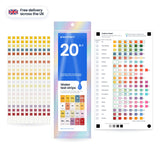
A strip indicates pH, hardness and copper, and the separate rapid test screens for coliform bacteria. Fill a clean glass with the water, dip one strip, wait 30 to 60 seconds and match the pads to the chart. Or scan the QR code on the chart, or go to the free results checker, and the report opens in your browser with no app or account. The bacteria test is an optional add-on, read after 24 to 48 hours. Our guides to testing your water at home and testing water for bacteria cover taking the sample. The last column is our own reading of the chart steps, not a claim from an official body.
| Check | Legal value (England, 2016 Regulations, Schedule 1) | What our chart can show |
|---|---|---|
| pH | 6.5 to 9.5 (indicator values) | The 6.2 and 6.8 steps sit either side of 6.5, and the top step, 8.4, is below 9.5 |
| Hardness | Not a Schedule 1 parameter | Steps run from 0 to 425, with the unit basis unconfirmed, so a reading is a rough comparison. See our hardness guide |
| Copper | 2.0 mg/l | Steps at 0.2, 0.5, 1, 2 and 5 mg/L, so 2 sits at the limit |
| Lead | 10 µg/l | The first colour step is 20 mg/L, far above the limit, so a clear pad is not a pass |
Several things are outside what the kit can do.
- The legal bacteria values are E. coli and enterococci, none in 100 ml, on a laboratory sample. Our rapid test is a presence screen for coliforms, not a count, and we do not claim it for rainwater. A clear result does not show the legal value is met.
- The strip does not read turbidity or conductivity, both on the council's default list.
- The strip cannot read lead at the UK limit. For pipework, see our guide to lead pipes in your house.
- A strip result is not a legal sample and has no legal effect.
If a reading surprises you, the official route starts with your local authority, which the DWI says can monitor a single home as part of an investigation when an owner raises a concern.
The area figure is an average, and your butt or tank is its own supply, so your tap may differ. The DWI says quality can vary with seasonal changes to the source water and with how well any treatment works. The pads that matter here are pH and copper, with hardness as a rough comparison. A move in the pH or copper pad between tests would show the water at your tap has changed, which is the kind of variation the DWI describes and a reason to raise it with your local authority. Best pack: 20 strips, enough to test your butt or tank after a dry spell, after heavy rain and again later, £5.99 (or £10.99 with a bacteria test), with free 2nd Class delivery on every order. See the kit
Your rainwater questions
Is rainwater safe to drink?
In the sources we read, no UK official page gives a flat answer. The DWI says a rainwater system used for domestic purposes, which includes drinking, is a private water supply. For private supplies in England, Schedule 1 sets E. coli and enterococci at 0 per 100 ml, and only sampling shows what a given butt or tank holds.
Can you drink rainwater?
The DWI treats a rainwater system supplying a home as a private supply, so the council regulates it. For single homes it tests only on request. Whether collecting it is lawful is a separate question, covered in our rainwater legality guide.
Is rainwater clean?
The sources we read do not describe rainwater as clean or otherwise. The regulations use measured values instead, so a statement about your own water needs a sample.
Is rainwater dirty?
We found no official figure for how much dirt rainwater carries in the sources we read. Turbidity is on the council's default test list, and Schedule 1 gives it a national requirement of 4 NTU.
Is rainwater drinkable?
For the law, drinkable means meeting the Schedule 1 values, such as copper at 2.0 mg/l, lead at 10 µg/l and pH 6.5 to 9.5 as an indicator. We found no single standard treatment for rainwater in the sources we read, and the WHO guidelines are among the DWI's listed references on general drinking water quality.
Sources
- World Health Organization, Guidelines for drinking-water quality, fourth edition incorporating the first and second addenda (overview page, undated).
- Drinking Water Inspectorate, Frequently asked questions and useful references (undated).
- Drinking Water Inspectorate, Information note on Regulation 3 (England, published 15 December 2022).
- Drinking Water Inspectorate, Information note on Regulation 3 (Wales) (published 15 December 2022).
- Drinking Water Inspectorate, What are private supplies? (undated).
- Drinking Water Inspectorate, Single dwelling supplies (undated).
- legislation.gov.uk, The Private Water Supplies (England) Regulations 2016, regulation 10.
- legislation.gov.uk, The Private Water Supplies (England) Regulations 2016, Schedule 1.
- Drinking Water Inspectorate, Governance framework for rainwater harvesting and greywater reuse systems report published (17 March 2026).
- Drinking Water Inspectorate, Catchment hazards (undated).
Contains public sector information licensed under the Open Government Licence v3.0.