

Do I need dishwasher salt in a soft water area?
Share
Part of our hard water guide
The kettle never furs up where you live, so is that bag of dishwasher salt under the sink doing anything?
Short answer: Often only a little. Which? says in a soft water area you can lower the hardness setting and are unlikely to top up the salt often, if ever, though it suggests adding some when the machine is new. United Utilities and Scottish Water class under 50 mg/l as calcium carbonate as soft.
By Andrew Tomlinson, WaterKit · Last reviewed 29 October 2026
Do you need dishwasher salt in a soft water area?
Usually much less than in a hard water area, and a quick check at your own tap with a 20-in-1 strip gives a hardness band reading for your water. Which? says dishwashers need very soft water to clean well, and the salt is what softens it. It says soft water owners can set the machine's hardness level to suit and are unlikely to top up often, if ever. It still suggests adding salt when the machine is new or has never been topped up, as a failsafe against cloudy glasses.
On all-in-one tablets, Which? says they contain some salt, but it often is not enough to protect dishes from cloudiness over many washes. It also says dishwasher salt is pure sodium chloride with no anti-caking agents, and that cooking salts often contain anti-caking agents, so it advises against using them instead. Salt for a plumbed-in softener is a separate matter, covered in our softener guide.
What dishwasher setting does your water hardness need?
The one in your manual that matches your supply's hardness. Which? says to ask your water supplier for the figure, then check the manual. Northern Ireland Water has a postcode tool showing hardness and dishwasher settings, and United Utilities points to a water quality page for appliance figures and a factsheet with conversion tables. Scottish Water notes that dishwasher makers use different units. Our postcode guide lists each company's lookup.
Which? says to expect millimoles per litre (mmol/l), but the United Utilities factsheet gives mg/l of calcium carbonate, with factors of 0.056 for German degrees (°dH) and 0.07 for degrees Clark. Dividing by about 100 gives mmol/l, our arithmetic from calcium carbonate's molar mass. So the 50 mg/l edge of the soft band is about 2.8 °dH, 3.5 °Clark or 0.5 mmol/l. Our hardness guide explains the bands.
Should there be water in the dishwasher salt compartment?
Yes, a little. Which? says that after the first use the softener unit should always hold some water, and you will not need to refill it. For a brand-new machine, follow your manual's first-fill steps.
Which? says to fill the salt only to the water level in the compartment, aiming for a salt brine rather than overflow. If you overfill, it says rinsing with water helps stop the softener clogging with salt. Salt goes only in the softener unit, never in the detergent, cleaner or rinse aid compartments.
How do you get hard water stains and buildup out of a dishwasher?
Mostly by preventing them. Which? says hard water can cloud glasses over time and clog the inside of the machine with limescale, and that salt stops limescale building up. Scottish Water lists white mineral deposits on dishes and glassware among the effects of hard water. Our limescale guide explains what the deposit is.
For cleaning, Which? suggests a hot empty wash twice a year, mainly against food residue and smells, and a proper dishwasher cleaner. It advises against lemon juice or white vinegar, and another Which? article says vinegar can tarnish the stainless steel and corrode the door seal, pump and drain pipe. Which? says rinse aid reduces water's surface tension, which helps prevent water marks, and that you might be able to turn the rinse aid setting up. If marks return in an area called soft, test the water at your own tap with a strip before blaming the salt.
Why might your own tap not match the area figure?
The area figure is an average. Your tap may differ, because United Utilities says most North West raw water comes from upland reservoirs that are soft or very soft, while some southern boreholes are reasonably hard and are usually blended with softer sources. Scottish Water says most of its raw water is soft to slightly hard, some borehole supplies are harder, and it can give a hardness level for any supply zone. A label such as "soft area" is not a reading for your street. A figure for the area does not tell you what comes out of your own tap.
Home plumbing matters too. United Utilities says a softener should be fitted after the drinking water tap, so in a home with one, our reading is that the kitchen drinking tap and the water reaching a dishwasher may not match.
“A "soft area" label is an average, so I would check your own tap before deciding what your dishwasher needs. If you have a softener at home, it is worth remembering the kitchen drinking tap and the water reaching the machine may not be the same.”
How can you check your tap's hardness for the dishwasher?
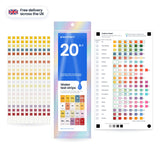
Fill a clean glass with cold kitchen tap water, dip one strip, wait 30 to 60 seconds and match the hardness pad to the chart, as our hardness testing guide explains. Scan the QR code on the chart, or go to the free results checker, to enter the colours. No app or account is needed. The pad indicates a band at your tap. Its unit basis is unconfirmed, so the columns below are our own arithmetic, set beside the United Utilities and Scottish Water bands as a rough comparison.
| Pad step (mg/L) | °dH (x 0.056) | °Clark (x 0.07) | Water company band, if the pad reads mg/l as calcium carbonate (our comparison) |
|---|---|---|---|
| 25 | 1.4 | 1.8 | Soft |
| 50 | 2.8 | 3.5 | Edge of soft and moderately soft |
| 100 | 5.6 | 7.0 | Edge of moderately soft and slightly hard |
| 250 | 14.0 | 17.5 | Hard (200 to 300) |
| 425 | 23.8 | 29.8 | Very hard (over 300) |
Three limits apply.
- The pad has steps at 0, 25, 50, 100, 250 and 425 mg/L, so a reading is a band that will not line up exactly with your dishwasher's levels.
- It cannot tell you which setting your model needs or whether the softener unit is working.
- A strip result is not a legal sample.
Best pack: 20 strips, enough to check your tap now and again after any change of supply or softener, £5.99 (or £10.99 with a bacteria test), with free 2nd Class delivery on every order. See the kit
Your dishwasher salt questions
Do you need dishwasher salt in soft water areas? Do I need dishwasher salt in soft water area?
Often little, according to Which?. Your manual has the final say.
Should there be water in dishwasher salt dispenser? Is the dishwasher salt compartment full of water? Should there be water in the dishwasher salt compartment?
Yes, a little. Which? says the unit should always hold some water after first use.
Why is my dishwasher salt compartment full of water? Why is the salt container in dishwasher full of water? Should salt reservoir in dishwasher full of water?
Which? says the softener unit should always hold water after its first use, and the salt dissolves in it to make brine.
Do I need to add water to dishwasher salt?
Not as a routine. Which? says you will not need to refill the water, and a new machine's first fill is in your manual.
How to get hard water stains out of dishwasher? How to get hard water stains off dishes in dishwasher?
Which? says salt stops limescale building up and rinse aid helps prevent water marks. It warns against vinegar in a dishwasher.
How to get rid of hard water buildup in dishwasher? How to clean hard water buildup in dishwasher?
Keep the salt topped up and use a proper dishwasher cleaner rather than vinegar, as Which? advises. The sources we read (three Which? guides and the Northern Ireland Water, United Utilities and Scottish Water pages) give no separate descaling method.
Sources
- Which?, Dishwasher salt and rinse aid explained (3 November 2025; soft water area, settings, water in the reservoir, tablets, overfilling, mmol/l, rinse aid; read 29 October 2026).
- Which?, How to clean a dishwasher (1 October 2026; hot empty wash, dishwasher cleaner; read 29 October 2026).
- Which?, 8 things you really shouldn't clean with vinegar (16 March 2026; dishwashers; read 29 October 2026).
- Northern Ireland Water, Water quality results (postcode tool for hardness and dishwasher settings; undated page; read 29 October 2026).
- United Utilities, Water hardness (North West sources, softener fitting; undated page; read 29 October 2026) and its Water hardness factsheet (ref 09/25/SD/10586-6335; bands in mg/l calcium carbonate, conversion factors 0.056 and 0.07; read 29 October 2026).
- Scottish Water, Factsheet 12, Hardness in drinking water explained (ref SWFact WH12 05/20; sources, bands, effects, units; read 29 October 2026).
- WaterKit, Water Test Kit (20-in-1 strip, 30 to 60 second read, from £3.99, free 2nd Class delivery on every order) and results portal (hardness pad steps 0, 25, 50, 100, 250 and 425 mg/L). The conversion table and the comments on readings are WaterKit's own arithmetic and reading of the chart, and the pad's unit basis is unconfirmed.
Contains public sector information licensed under the Open Government Licence v3.0.