

Why is London water so hard?
Share
Part of our hard water guide
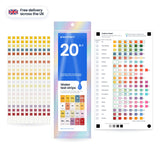
You moved to London and the kettle furred up within weeks. Where does all that chalk come from? You can check your own tap with a 20-in-1 test strip.
Short answer: Because London's water comes from chalk and limestone country. The British Geological Survey says Chalk can be over 98% calcium carbonate and its groundwater is 200 to over 400 mg/l hard. Thames Water's 2025 averages for four south-west London zones were 251 to 268 mg/l, which the DWI calls hard (200 to 300).
By Andrew Tomlinson, WaterKit · Last reviewed 29 October 2026
Why is London water so hard?
Because much of it has soaked through chalk or limestone, rocks that dissolve slightly into the water. The Drinking Water Inspectorate (DWI), the regulator, says hardness is caused by dissolved calcium and magnesium and varies with local geology. A figure for London is only a starting point.
The British Geological Survey (BGS) describes the Chalk Group as mostly chalk, a very fine-grained, pure limestone that may contain more than 98% calcium carbonate. It forms the Chiltern Hills and the North Downs and crops out around the margins of the London Basin. The BGS says rain soaking into the Chalk has its acidity quickly neutralised and takes calcium carbonate into solution. Chalk groundwater has a total hardness of 200 to over 400 mg/l as calcium carbonate, though it may fall below 200 beneath the clays covering the Chalk under London. These figures come from a 1996 edition, so treat them as a general picture. Our limescale guide covers what the scale is.
Where does London's water come from?
Mostly the River Thames, stored in reservoirs, with the rest from boreholes into underground aquifers. Thames Water's 2024 water resources plan says its London zone is largely based on abstraction from the River Thames (80%), with the remainder from boreholes.
A river can still carry chalk. The BGS says about 60% of the Thames's flow at Teddington Weir comes from natural groundwater discharge (a 1996 figure). Our reading is that much of the river water has also spent time underground. The Environment Agency adds that London Clay and city surfaces stop rain reaching the Chalk under central London, so that Chalk is confined and its water mainly comes from the Chilterns and the North Downs. The four suppliers describe their sources like this.
| Supplier | What it says about its sources |
|---|---|
| Thames Water | All the water in its region is hard because it passes through chalky limestone, and hardness is a characteristic of the source, so it cannot control it |
| Affinity Water | Around 65% of the water it supplies comes from chalk groundwater, and about 60% of its Central region supply from groundwater, the rest from the Thames or imports (2023 drought plan). It supplies parts of north-west London |
| SES Water | Much of its water is taken from boreholes in limestone or chalk rocks, which tends to be naturally hard (July 2026 factsheet) |
| Essex and Suffolk Water | Supplies Barking and Dagenham, Havering and Redbridge from its Essex zone, which draws on local rivers feeding reservoirs plus a bulk supply from Thames Water (2023 draft plan summary). Water near limestone or chalk, or with groundwater, is probably hard |
Your postcode decides which one is yours. Our London tap water guide shows who supplies where.
How hard is it, in numbers?
Hard on the DWI's scale in every zone report we read. The DWI calls 200 to 300 mg/l (as calcium carbonate) hard and over 300 very hard. Thames Water's 2026 zone reports cover 1 January to 31 December 2025. These are the four London zones we could open.
| Thames Water zone | Lowest | Average | Highest | Samples |
|---|---|---|---|---|
| Battersea North | 232 | 258 | 279 | 4 |
| Battersea South | 264 | 268 | 273 | 4 |
| Kingston North | 242 | 259 | 271 | 4 |
| Kingston South | 232 | 251 | 268 | 5 |
They cover south-west London only. Our hardest tap water guide lists five central zones from Thames Water's own checker, read on 20 October 2026, at 261 to 273 mg/l. That is hard, but not among the ten hardest zones we found, topped by 402 mg/l at Ipswich South on Anglian Water's figures. To look up yours, see our hardness by postcode guide.
Why doesn't the water company soften it?
The rules set no standard for hardness, and the companies we read differ. Thames Water says it cannot control it. SES Water says it softens its water slightly as part of treatment. The DWI says UK drinking water regulations specify no standards for hardness, calcium or magnesium, and recommends that a company which artificially softens water keeps a minimum total hardness of 150 mg/l as calcium carbonate.
Why might my tap differ from the London figure?
The area figure is an average. Your tap may read differently, because a zone figure is built from a handful of samples. Thames Water says its zone reports cover the whole supply zone and are not specific to any one property. In the table above, Battersea North ran from 232 to 279 mg/l across just 4 samples. The DWI says its own map of typical hardness leaves out areas with local variation, and tells you to ask your water company for an accurate measurement.
Supply mix matters too. Affinity Water says part of its supply comes from groundwater and the rest from the Thames or imports, and Essex and Suffolk Water says blended supplies vary in hardness. A figure for the area does not tell you what comes out of your own tap.
“I would treat the zone figure as a starting point, not the answer for your kitchen, because it is an average across a whole supply area. Checking the tap you actually use is a sensible way to see how your own water compares.”
The DWI says hard water causes scaling in hot water systems, kettles, electric irons and domestic appliances. It says scale on heating elements shortens their life and makes appliances less efficient, and that hard water gives less lather from soap and washing powders. Our kettle limescale guide shows how that builds up.
What one reader found
In a 2019 Mumsnet thread about limescale in kettles, one poster put theirs down to hard London water. They wrote, "I get about half a ml of limescale from one full kettle". They had switched to a glass kettle so the scale was visible, and descaled every week or two. It is one person's account, not a measurement. Shared on Mumsnet
How can I check my own tap?
Test the tap you use, then compare it with your supplier's zone figure. Fill a clean glass or cup with water from your kitchen tap, dip one strip, wait 30 to 60 seconds and match the hardness pad to the chart, or enter the colours in our free results checker. Our hardness testing guide has the full method.
The pad has colour steps at 0, 25, 50, 100, 250 and 425 mg/l. The next lines are our own reading of the chart, not a claim from the DWI. The unit basis of the pad is unconfirmed, so we read it as calcium carbonate to compare it with the DWI's bands. On that reading a result near 250 indicates the hard band, which is where the Thames Water averages above sit, and 425 indicates the very hard band. The pad shows a band, so it cannot tell a zone average of 258 from one of 273. It also cannot show where your water came from, and a strip result is not a legal sample. Reading a few different days shows how steady your tap is.
Best pack: 20 strips, enough to read your kitchen tap on several days and compare it with the figure for your zone, £5.99 (or £10.99 with a bacteria test), with free 2nd Class delivery on every order. See the kit
Your London water hardness questions
Does London have hard water?
Yes. Thames Water says all the water in its region is hard, and its four zone reports above average 251 to 268 mg/l. Affinity Water and SES Water also tie much of their water to chalk or limestone.
Is London water hard or soft?
Hard on the DWI's scale, which calls 200 to 300 mg/l hard and up to 100 soft. For contrast, our Manchester guide covers a soft water city.
Is London hard water?
Yes, in the zones we read. It is hard but not among the hardest zones we found in company figures, which include Ipswich, Hull and Cambridge.
Is London a hard water area?
Yes. Thames Water says its water passes through chalky limestone, and the BGS says the Chalk around the London Basin holds very hard groundwater.
Why is London water so hard?
The water has soaked through Chalk, which the BGS says can be over 98% calcium carbonate, and has taken some of it into solution.
Sources
- Drinking Water Inspectorate, Water hardness (bands in mg/l calcium carbonate; no UK standard; 150 mg/l minimum where companies soften; scaling; ask your water company; undated page; read 29 October 2026).
- British Geological Survey, London and the Thames Valley, British regional geology, 4th edition, 1996 (Chalk composition, outcrop and groundwater hardness; Thames flow at Teddington Weir; figures may have changed; read 29 October 2026).
- Environment Agency, London abstraction licensing strategy (London Clay, confined Chalk, recharge from the Chilterns and North Downs; read 29 October 2026).
- Thames Water, Water Resources Management Plan 2024 (London zone sources); Water quality reports 2026 for Battersea North, Battersea South, Kingston North and Kingston South (hardness as calcium carbonate, 1 January to 31 December 2025); and its hard water help page. Read on thameswater.co.uk; Thames Water allows links to its home page only.
- Affinity Water, Drought Management Plan 2023 (chalk groundwater share; north-west London). Affinity Water allows links to its home page only.
- SES Water, factsheet Water hardness and limescale, July 2026 (boreholes in limestone or chalk; slight softening). SES Water allows links to its home page only.
- Essex and Suffolk Water, Draft Water Resource Management Plan 2024 summary, March 2023, and Hard water in your area (both read on eswater.co.uk). It asks for permission for any link, so none is given.
- Mumsnet, Limescale off. Is your kettle worse than this? (thread of 12 June 2019; read 29 October 2026).
- WaterKit, Water Test Kit and results portal (hardness steps 0, 25, 50, 100, 250 and 425 mg/L). The reading of the chart steps against the DWI's bands is WaterKit's own.
Contains public sector information licensed under the Open Government Licence v3.0.