

Where does UK tap water come from, and how is it treated?
Share
Part of our tap water guide
Your glass of tap water began in a river, a reservoir or a borehole. What happened to it on the way, and what happens in the last few metres, which you can check at your own tap with a 20-in-1 test strip?
Short answer: England's public supplies drew on 1,184 surface, 976 groundwater and 241 mixed sources in 2025, according to the Drinking Water Inspectorate, with 989 treatment works serving 59.74 million people. Wales had 257 surface, 42 groundwater and 1 mixed source. Works treat the water, and Scotland's regulator says plumbing inside a property can affect test results.
By Andrew Tomlinson, WaterKit · Last reviewed 25 October 2026
Where does UK tap water come from?
From surface water and groundwater, which the regulators count by type. The Drinking Water Inspectorate (DWI) reports the figures below for 2025. A count of sources is not a share of the water supplied, so it does not tell you which source feeds your street. We show what a strip can and cannot read at the end.
| Nation, 2025 | Sources (surface, groundwater, mixed) | Treatment works | Supplied |
|---|---|---|---|
| England | 1,184, 976 and 241 | 989 | 14.48bn litres a day to 59.74 million consumers, from 24 water companies |
| Wales (DWI Wales report) | 257, 42 and 1 | 69 | 926,342,000 litres a day to 3,313,500 people |
The sources we read give no matching count for Scotland. In Northern Ireland, the DWI's 2024 report says over 99% of people receive water from NI Water and the rest from private supplies. It gives public compliance as 99.88% for 2024.
Does the source change what is in the water?
Yes, the DWI's 2025 report ties several substances to the source. It says nitrate is most commonly linked to farm fertiliser and manure in drinking water catchments, can persist in groundwater for long periods, and can affect surface sources after rain. It reports 2 nitrate exceedances from 24,518 tests in 2025, against a 50 mg/L standard.
It says high iron and manganese are most often linked to groundwater sources or to deposits stirred up in the pipes, and that iron, manganese and aluminium made up 29% of chemical failures in 2025. It also lists algae in source waters among causes of taste and odour problems. The sources we read do not say how hardness varies with geology, so see our hardness by postcode guide for your own figure.
How is tap water treated before it reaches me?
At a treatment works, in stages that differ between works. The sources we read do not list every stage, so we only report what the DWI's 2025 report describes. It says turbidity, the cloudiness caused by suspended particles, is measured at works because it shows whether raw water has been adequately treated before disinfection. The works standard is 1 NTU, and there were 12 failures from 171,515 tests in England in 2025.
Two Anglian Water works show how it looks locally. At Pitsford, a surface water works in Northamptonshire, a February 2025 sample read 1.48 NTU, with iron at 335 µg/L against a 200 µg/L standard. The DWI report links this to stagnant water in a short length of cast-iron pipe after pump maintenance. At West Pinchbeck, near Grantham, which treats groundwater from five artesian boreholes, a January 2025 sample read 1.10 NTU, linked to elevated iron and manganese.
On chemicals, the DWI says aluminium exceedances are more commonly linked to treatment performance, especially where aluminium-based coagulants are used. There were 10 aluminium failures from 52,398 tests in 2025 against a 200 µg/L standard. It also says some zones use chloramination to keep a disinfectant residual in the network, and that chlorine tastes can occur where dosing is elevated (see our chloramine guide).
Why might water from my tap differ from the figures for my area?
The area figure is an average. Your tap sits at the end of pipes and fittings the works never sees. Scotland's drinking water regulator says zone results come from randomly chosen taps and are taken as representative of the zone, but certain parameters may vary significantly within it. It adds that plumbing in the property can affect results, especially for lead, copper and nickel. A figure for the area does not tell you what comes out of your own tap.
“The area figure is an average, but your tap sits at the end of pipes and fittings that the works never sees. That is why I would always check your own tap rather than lean on the zone result.”
The DWI's 2025 report gives sourced examples.
- Nickel. 72 tests missed the 20 µg/L standard, 19% of chemical failures. The DWI says most were associated with consumer distribution systems and commonly linked to new taps or fittings.
- Copper. The DWI says it mainly comes from internal plumbing, including storage tanks. A Wessex Water sample taken before flushing read 2.1 mg/L, and 0.04 mg/L after flushing, in a home with new copper pipework from a kitchen refit.
- Lead. There were 60 compliance sample failures for lead. The DWI says it comes mainly from water company communication pipes and from consumer-owned supply pipes and fittings, and that the problem is largely within homes. Our lead pipes guide shows how to check.
- Water softeners. The DWI traced a 290 mg/L sodium result (standard 200 mg/L) to a domestic softener on the sampled tap, and a salty-tasting sample at a Portsmouth Water hotel to an unnoticed softener.
- Taste and odour. United Utilities reported 13 odour and 11 taste exceedances between January 2020 and June 2025 in four zones supplied from Buckton Castle works, and the DWI began enforcement.
Private supplies are not in the water companies' figures at all. The DWI reports them separately, with 34,102 in England serving 818,213 people, of which 3,119 had no risk assessment. In Wales there were 14,902, and 11,756 had none. Northern Ireland's private supplies had 99.12% compliance in 2024. Discolouration is covered in our brown or cloudy water guide.
How do I find my supplier and my area's water quality?
Enter your postcode in the "Find your supplier" tool on the Water UK home page, which covers water and wastewater services. For English zones, the DWI's annual report holds national test and compliance tables. The pages we read do not say how each English company publishes zone results, so your supplier is the one to ask. In Scotland the regulator points to Scottish Water's own lookup, which draws on more than 150,000 tests a year.
What can a strip show at my own tap?
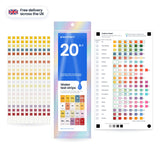
Several of the things the official reports discuss, though only some at their limits. Fill a clean glass or cup with tap water, dip one strip, wait 30 to 60 seconds and match the pads to the chart, or enter the colours in our free results checker. The last column is our own reading of the chart steps.
The strip cannot read lead at the UK limit, and its iron, nitrite and fluoride pads also start above their limits, so use the lead pipes guide above for lead. It cannot show which source feeds your tap or which treatment stages it went through, and a result is not a legal sample. The optional rapid bacteria test is a presence screen for coliforms, read after 24 to 48 hours, not a count. Testing steps are in our home water testing guide.
| Check | Official figure (DWI, 2025) | What our chart can show |
|---|---|---|
| Free and total chlorine | None in the sources we read | Steps at 0.5, 1, 3, 5, 10 and 20 mg/L. A coloured pad indicates a residual is present. A clear pad means none detected at the first step of 0.5 |
| Hardness | None in the sources we read | Steps at 25, 50, 100, 250 and 425 mg/L, with the unit basis unconfirmed, so a reading is a rough comparison with your postcode figure |
| Nitrate | 50 mg/L at consumers' taps | 25 or below indicates under the limit, 50 at or near it, 100 or more above it |
| Copper | 2 mg/L at the tap | Steps at 0.2, 0.5, 1, 2 and 5 mg/L, so 2 sits at the limit |
| Aluminium | 200 µg/L (0.2 mg/L) | The first colour step is 5 mg/L, 25 times the limit, so a clear pad is not a pass |
The area figure is an average, and Scotland's regulator says plumbing in the property can affect results, especially for copper, so your own tap may read differently from your zone. The pads that matter for this topic are nitrate, copper and chlorine. A nitrate pad at 100 or more would sit above the 50 mg/L standard, a copper pad at 2 or higher would be at or over the 2 mg/L limit, and a chlorine pad that turns from clear to coloured would indicate a residual is present. Best pack: 20 strips, enough to test your kitchen tap first thing, again after running it, and at a second tap, £5.99 (or £10.99 with a bacteria test), with free 2nd Class delivery on every order. Scan the QR code on the chart for your free report, or see the kit.
Your tap water source and treatment questions
Where does tap water come from?
Surface, groundwater and mixed sources, which the DWI counted at 1,184, 976 and 241 in England in 2025.
Where does drinking water come from?
For public supply, the same sources. Private supplies are reported separately, with 34,102 in England in 2025 according to the DWI.
Is tap water distilled?
By our reading, no. The sources we read describe no distillation stage, and the DWI's 2025 tests record iron, nickel, sodium and nitrate in tap water samples. Our distilled water guide explains what distilled means.
Is tap water filtered? Is UK tap water filtered?
At some works, yes. The DWI describes filtration stages and pre-filter and post-filter run-to-waste routes at West Pinchbeck, but the sources we read do not say every works filters. A jug or tap filter at home is separate.
Is tap water reverse osmosis?
The sources we read do not mention reverse osmosis in public supply, and we found no source saying all tap water goes through it. Our reverse osmosis guide covers home units.
What is reverse osmosis in water treatment?
The sources we read give no definition for treatment works, so we do not describe it here. The same guide explains the process.
How is water filtered? How is water filtered for drinking? Why is water filtered?
The DWI says turbidity, cloudiness from suspended particles, shows whether raw water has been adequately treated before disinfection. The works standard is 1 NTU, and the report records 12 failures from 171,515 tests in 2025.
Why use chlorine in water treatment? Why is chlorine used in water treatment?
The DWI says some zones use chloramination to maintain a residual disinfectant in the downstream network, and that chlorine tastes can occur where dosing is elevated. The pages we read say no more on why, so see our chloramine guide.
Why is aluminium sulphate used in water treatment?
The DWI's 2025 report names aluminium-based coagulants but does not explain their use in the pages we read. It says aluminium exceedances are more commonly linked to treatment performance where they are used.
Who is my mains water supplier?
Enter your postcode in the "Find your supplier" tool on the Water UK home page.
What is the water quality in my area? What is the tap water quality in my area? How do I check the water quality in my area?
Ask your supplier for your zone's results, and read the DWI annual report for national tables. In Scotland, the regulator points to Scottish Water's lookup, and a strip shows your own tap.
Where does water come from in a well?
The sources we read do not describe a well's source. The DWI counts private supplies separately, and our well and borehole guide covers where they draw from.
Sources
- Water UK, water.org.uk home page ("Find your supplier" postcode tool for water and wastewater services; undated; read 29 October 2026). Water UK's terms allow a link to its home page, and no endorsement is implied.
- Drinking Water Inspectorate, Drinking Water 2025, England, water supplies and testing (24 companies; 59.74 million consumers; 14.48bn litres a day; 989 treatment works; 1,184 surface, 976 groundwater and 241 mixed sources; private supplies 34,102, 818,213 people, 3,119 without a risk assessment; undated; read 29 October 2026).
- Drinking Water Inspectorate, Learning from turbidity failures (1 NTU; 12 failures from 171,515 tests; Pitsford and West Pinchbeck; undated; read 29 October 2026).
- Drinking Water Inspectorate, Learning from chemical, taste and odour failures (nitrate, iron, manganese, aluminium, nickel, lead, copper, sodium, chloramination, taste and odour, Wessex, Portsmouth and United Utilities cases; undated; read 29 October 2026).
- Drinking Water Inspectorate, Drinking Water 2025, Wales, water supplies and testing (257 surface, 42 groundwater and 1 mixed source; 69 works; 3,313,500 people; 926,342,000 litres a day; private supplies 14,902, 11,756 without a risk assessment; undated; read 29 October 2026).
- Drinking Water Quality Regulator for Scotland, Check Your Local Water Quality (Scottish Water lookup; over 150,000 tests a year; random taps; plumbing can affect results; undated; read 29 October 2026).
- Drinking Water Inspectorate for Northern Ireland, Annual Report on Drinking Water Quality in Northern Ireland in 2024 (over 99% supplied by NI Water; 99.88% public and 99.12% private compliance; read 29 October 2026, foreword only).
- WaterKit, Water Test Kit (20-in-1 strip, 30 to 60 second read, optional rapid coliform test read after 24 to 48 hours, from £3.99, free 2nd Class delivery on every order, 30-day money-back guarantee) and results checker. The strip-chart column is WaterKit's own reading of the colour chart steps.
Contains public sector information licensed under the Open Government Licence v3.0.