

How do you treat well or borehole water?
Share
Part of our well and borehole water guide
Iron, nitrate, germs or a low pH reading on your well or borehole water. Which fix matches which problem, and how do you know it is working? You can check at your own tap with a 20-in-1 test strip.
Short answer: The Drinking Water Inspectorate (DWI) says treatment depends on what is in the water. It describes ultraviolet light for germs, aeration then filtration for iron, and ion exchange for nitrate. UV needs roughly 40 mJ/cm2, and lamp output falls to about 70% after 10 to 12 months. A sample result shows which route fits.
By Andrew Tomlinson, WaterKit · Last reviewed 29 October 2026
Where do you start when treating well or borehole water?
With a result, not with equipment. The DWI's treatment guide says the type and design of treatment depend on the properties of the water and the contaminants in it.
Source protection and council testing are in our well and borehole water guide, and what a borehole is has the basics. The DWI says that where a hazard is natural or persistent, some treatment will be needed in most cases, and that its operation should be verified by sampling and analysis.
Which treatment suits which problem?
Usually a series of stages, with pre-filtration first and disinfection last, which the DWI's page on physical removal of contaminants calls the multiple barrier principle.
| Problem | Route the DWI describes | What it says to watch |
|---|---|---|
| Germs | Ultraviolet (UV) light, or chlorine | UV needs clear water, with pre-filtration to under 1 NTU where Cryptosporidium is likely. Pond or fish tank UV units are not suitable |
| Iron and manganese | Oxidation, usually by aeration, then filtration | Proprietary units reach around 200 µg/l (0.2 mg/l) of iron or 50 µg/l of manganese, or lower, and need periodic backwashing |
| Nitrate | Ion exchange | The resin is regenerated with salt solution, and the waste has to be disposed of |
| Low pH | Dosing an alkali, an alkaline bed, or aeration | Soft acidic water can corrode pipework and dissolve copper, zinc and lead |
| Radon (groundwater in some parts of the UK) | Aeration, fitted before the water enters the building | Units at the tap are not suitable, because radon escapes as a gas |
Should you treat the whole supply or just one tap?
The whole supply, according to the DWI's point of use guidance, which advises it in preference wherever possible and without exception where the supply is used commercially or by the public. It says point of use treatment may cost less but can leave uncontrolled risks at taps without it.
Why might the water at your tap differ from what the treatment is meant to deliver?
- The unit may not be delivering. The DWI says a UV lamp still looks lit when its output has dropped, and that without an automatic cut-off a lamp or power failure leaves the water undisinfected.
- The pipework and tanks. In its guidance on protecting a private supply, the DWI lists corroded or deteriorating pipework, sludge in storage tanks, stagnant water and lead pipework among the distribution risks (see how to tell if your house has lead pipes and the loft tank).
- Changes over time. The DWI says turbidity changes after heavy rain may indicate rapid recharge bringing contaminants from the surface, and that dirty or discoloured water should be investigated (record keeping guidance).
“If your supply has treatment fitted, I would not assume it is still doing its job just because the unit looks fine, as the guide points out a UV lamp can look lit when its output has dropped. Checking the water at your own tap, and at the source on the same day, is a sensible way to see what actually reaches the glass.”
What one reader found
A poster on a horse forum describes borehole water with very high iron, which they think is sulphide, and far too much manganese. They also had a rotten egg smell and were quoted thousands of pounds to fix it. They say a big deioniser fixed the iron and manganese ("We just have a big deioniser that takes it all out"), and that a carbon filter changed every 6 months for £25 fixed the smell. These are one person's claims, not tested results, and the smell is covered in why does my tap water smell of eggs. Shared on the Horse & Hound forum.
How can you check at your own tap whether treatment is doing its job?
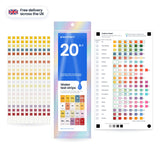
A strip gives a quick screen for some of these problems, but the official check is a council sample, and a strip result has no legal effect. The WaterKit Water Test Kit has a 20-in-1 strip you dip for 30 to 60 seconds and match to the chart, plus an optional rapid coliform bacteria test read after 24 to 48 hours. Arsenic, turbidity in NTU, Cryptosporidium, pesticides and radon are outside what the kit can read. Our home water testing guide covers the steps, and you can scan the QR code on the chart or use the free results checker in your browser, with no app or account. The right-hand column below is our own reading of the chart steps.
| Check | Figure in the DWI pages | What our chart can show |
|---|---|---|
| Nitrate | No figure on the pages we read | Steps at 10, 25, 50, 100, 250 and 500 mg/l, so a lower step after treatment than before indicates less nitrate in that sample |
| Manganese | Units reach around 50 µg/l (0.05 mg/l) or lower | The first step is 0.05 mg/l, at that figure |
| Iron | Units reach around 200 µg/l (0.2 mg/l) or lower | The first step is 1 mg/l, five times that figure, so a zero means none detected at 1 mg/l |
| pH | The UK regulations give a range of 6.5 to 9.5 (indicator parameter) | Steps from 6.2 to 8.4; we give no pass or fail from it (see what pH drinking water should be) |
| Germs after UV or chlorine | The DWI says UV or chlorine treat bacteria | A yellow result indicates coliforms in that sample. A purple one does not show that the UV dose is enough (see how to test water for bacteria) |
A general figure for your area is an average, and your own tap can differ, because the DWI says a UV lamp can look lit when its output has dropped and that pipework, tanks and taps without treatment all sit between the unit and the glass. The pads that matter here are nitrate, iron, manganese and pH, where a step that moves after treatment, or between the source and the tap, indicates something has changed, and a yellow bacteria result indicates coliforms in that sample. Best pack: 20 strips, enough to test the source, the tap and a second tap before treatment, after it and again through the year, £5.99 (or £10.99 with a bacteria test), with free 2nd Class delivery on every order. See the kit
Your treatment questions
How to get rid of iron in water? How do I remove iron from my well water? How to remove iron from well water? How to filter iron from well water?
The DWI says dissolved iron is oxidised, usually by aeration, to insoluble ferric hydroxide, then filtered out. If the iron is in an organic complex, it says a strong oxidant such as chlorine or potassium permanganate is needed.
Is there iron in water? Does water have iron in it?
The DWI says iron in groundwater is usually present as dissolved ferrous compounds, and that naturally occurring salts of iron or manganese can colour water.
Is iron in water bad for you? What is a safe level of iron in drinking water?
We make no health claim, and the DWI pages we read give no health-based figure for iron. They say relatively high iron can give water an unpleasant metallic taste.
What type of filter removes arsenic from water?
We found no arsenic section in the DWI treatment guide, and the strip has no arsenic pad. Ask your local authority, which the DWI describes as the regulator of private supplies.
How to correct low pH in well water?
The DWI lists dosing an alkali, passing the water through an alkaline bed, or removing carbon dioxide by aeration.
What is a well water filtration system?
There is no single device. The DWI describes pre-filtration, filtration, then disinfection, with extra units where needed.
How to clean well water? How to purify well water for drinking? How to purify borehole water? How to make borehole water safe for drinking? How to treat borehole water for drinking? How to treat borehole water at home?
The DWI gives no single method. Its route is to find what is in the water, protect the source, then fit treatment designed for those risks and verify it by sampling.
How to remove iron bacteria from well water?
We found nothing on iron bacteria in the DWI pages we read. Ask your local authority or an installer.
What to do with an old water well UK? How to restore an old water well?
The DWI advises covering and backfilling or sealing abandoned wells and boreholes. The pages we read do not cover restoring one, so ask your local authority before drinking from it.
Sources
- Drinking Water Inspectorate, Treatment Guide (undated page; choosing suppliers; read 29 October 2026).
- Drinking Water Inspectorate, Chemical removal of contaminants (undated page; pH, iron and manganese, nitrate; read 29 October 2026).
- Drinking Water Inspectorate, Physical removal of contaminants (undated page; multiple barrier principle, membranes; read 29 October 2026).
- Drinking Water Inspectorate, UV disinfection (undated page; 40 mJ/cm2, lamp life, pre-filtration, iron and manganese figures; read 29 October 2026).
- Drinking Water Inspectorate, The physical and chemical properties of water (undated page; pH range, hardness, colour, turbidity, radon; read 29 October 2026).
- Drinking Water Inspectorate, Comparison of treatment capabilities (undated page; filters, ion exchange, UV; read 29 October 2026).
- Drinking Water Inspectorate, Point of use treatment (undated page; whole supply against point of use; local authorities as regulators; read 29 October 2026).
- Drinking Water Inspectorate, Checklist of questions to ask an installer (undated page; read 29 October 2026).
- Drinking Water Inspectorate, Protecting your private water supply (undated page; treatment verification, distribution risks, abandoned wells; read 29 October 2026).
- Drinking Water Inspectorate, Record keeping (undated page; maintenance, discoloured water; read 29 October 2026).
- Horse & Hound forum, Possible sulphates in borehole water (one poster's account, unverified; seen 29 October 2026).
- WaterKit, Water Test Kit (20-in-1 strip, 30 to 60 second read, optional rapid coliform test read after 24 to 48 hours, 20 strips £5.99 or £10.99 with a bacteria test, free 2nd Class delivery on every order) and results portal. The strip-chart column is WaterKit's own reading of the colour chart steps.
Contains public sector information licensed under the Open Government Licence v3.0.