

How do you make distilled water at home?
Share
Part of our bottled and other water guide
A steam iron, a battery or a machine asks for distilled water, and a pan of steam looks like the cheap way to get it. So what do UK sources say about doing it at home? You can also check what your own tap carries with a 20-in-1 test strip.
Short answer: A Newcastle University page describes distillation as heating water so the vapour rises, cools and collects in a second vessel, but says the volume is low and fuel costs can make it expensive. In the sources we read, no UK official body gives a home method. An RSC school practical collects just 1 cm³ from 20 cm³.
By Andrew Tomlinson, WaterKit · Last reviewed 29 October 2026
Is there UK guidance on making distilled water at home?
Not in the sources we read, and we have not turned any of them into a method. The RSC's teaching notes say distilled water should contain no dissolved solids and tap water some, so it helps to know what your own tap carries first, some of which a 20-in-1 test strip can indicate in under a minute. Two sources describe distillation, and the table shows what each one is and is not.
| Source | What it describes | What it is not |
|---|---|---|
| Royal Society of Chemistry (RSC) Education, a practical for 14 to 16 year olds | Boiling a coloured solution and collecting the condensed liquid, which the RSC calls the distillate, to obtain pure water | A teacher-led school practical with eye protection and a risk assessment, not a household method |
| Newcastle University, Water Quality Maps, an undated page from a university research project | Says distillation can be used at household level, but the fuel for heating can be costly and the volume of water is low | Not official guidance. We do not use its apparatus lines |
Our guide to what distilled water is covers the water itself. This one covers making it, and the sources stop at the principle.
How much water does home distillation give?
Little, going by the two sources. The RSC practical is built to produce a sample to test, not to supply water. It tells learners to stop heating once 1 cm³ of distillate has been collected from 20 cm³ of solution, then to test that sample for water. The Newcastle page says the method can be expensive because of the cost of fuel for heating, and that the volume produced is low. In the sources we read, there is no UK official figure for the output or energy use of a household still, so we give none.
What do UK bodies say about burns and scalds from boiling and steam?
The NHS says scalds are caused by hot liquids or steam. In the sources we read, there is no UK official safety guide written for home distillation, so these are general statements, each from the body named.
- NHS. Hold a burn or scald under cool running water for 20 minutes, as soon as possible and within 3 hours. Call 999 or go to A&E for one that is very large or deep, or on the face, genitals or bottom. Get help from NHS 111 if you are not sure what to do.
- RSC. Its practical warns that if it runs too long the ice water can heat up and scalding steam can come out of the test tube. It says learners must wear eye protection, warns that hot glassware can cause burns, and says to carry out a risk assessment first.
- NHS on young children. The NHS baby and toddler safety page says a baby's skin burns more easily than an adult's, and advises a cordless kettle or one with a short or curly flex and saucepan handles turned to the back.
- Burn specialists. In a 2025 warning about steam inhalation, the Northern Regional Burn Centre said it sees serious scald injuries from hot water, often to the face, chest, abdomen and legs, and called them preventable. That warning is about bowls of boiling water for colds, not distilling.
Those are the reasons we give no apparatus or technique of our own.
Is boiled water the same as distilled water?
No. A kettle or pan collects no steam, so boiled water is not distilled. The Drinking Water Inspectorate (DWI) says temporary hardness, the calcium and magnesium carbonates and bicarbonates, can be removed by boiling, forming scale. That is a different thing from distilling. See is boiled water the same as distilled and what boiling changes.
How do you get distilled water without making it?
In the sources we read, none says where to buy it. The RSC lists distilled (or deionised) water among the chemicals for a class practical, which names the product but not a shop. Check the label for what the water is sold for, and your appliance handbook for what it accepts. Our guides explain deionised versus distilled, tumble dryer water and reverse osmosis water, which are separate questions.
Why might your own tap water leave more behind than the area figure suggests?
The area figure is an average. Your tap may leave more or less, because the DWI says hardness varies with local geology and that its map of typical hardness does not show areas with local variation. A figure for the area does not tell you what comes out of your own tap.
The DWI classes water up to 100 mg/l as calcium carbonate as soft, 200 to 300 as hard and above 300 as very hard. It says hard water causes scaling in hot water systems, kettles, electric irons and domestic appliances, and that scaling of heating elements shortens their life. The RSC's teaching notes say tap water contains some dissolved solids, including those causing hardness, where distilled water should contain none, and its practical shows this by evaporating each to see the residue.
“The area figure is only an average, so I would always check your own tap before assuming it matches, especially if you are relying on it for an iron or a machine that wants very low minerals. A quick strip reading from your own kitchen tells you more than a map of the wider area.”
So the starting water matters. Our hardness guide, the postcode check and the guide to kettle limescale explain how to find your area's band. The hardness pad on the strip gives a reading from your own tap.
What can a test strip show on water you made or bought?
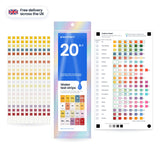
It can indicate whether a sample carries the mineral readings that distilled water should not have. Fill a clean glass or cup, dip one strip, wait 30 to 60 seconds and match the pads to the chart, or scan the QR code on the chart to open the free results checker with no app or account. The table is our own reading of the chart steps against the RSC statement. We have not run strips on water from a household still or on bottled distilled water, so it is a reading of the chart and not a test result.
| Pad | Chart steps (mg/L) | What to expect on distilled water |
|---|---|---|
| Hardness | 0, 25, 50, 100, 250, 425 | The zero step. Any higher step indicates dissolved calcium and magnesium |
| Total alkalinity | 0, 40, 80, 120, 180, 240 | The zero step |
| Sodium chloride | 0, 100, 250, 500, 1000, 2000 | The zero step, which means below the first step of 100 |
| Free and total chlorine | 0, 0.5, 1, 3, 5, 10, 20 | The zero step |
| Copper | 0, 0.2, 0.5, 1, 2, 5 | The zero step |
| Nitrate | 0, 10, 25, 50, 100, 250, 500 | The zero step, which means none detected at the first step of 10 |
Test your tap on the same day. In our reading, if your tap shows a hardness step above zero and the sample shows the zero step, the sample indicates hardness below the pad's first step of 25. Tap water below the first step of 25 would read zero too, and the hardness pad's unit basis is unconfirmed, so this is a rough comparison. How to test water hardness at home covers the dip. Several limits apply.
- A zero means none detected at that pad's first step, which is not the same as nothing being there.
- We give no pH reading for distilled water and have not tested the pH pad on it.
- The strip has no pad for volatile substances such as solvents.
- The optional bacteria test is a presence screen for coliforms in drinking-water samples, read after 24 to 48 hours. We do not claim it for bottled water, distilled water or water in a humidifier or other appliance.
- A strip result has no legal effect.
Best pack: 20 strips, enough to test your tap and a sample side by side and repeat the check later, £5.99 (or £10.99 with a bacteria test), with free 2nd Class delivery on every order. See the kit
Your questions about making distilled water
How to make distilled water
In the sources we read, no UK official body gives a method, so we do not give one. The RSC describes a school-laboratory practical and Newcastle University describes the principle, and the NHS and the RSC both warn that steam can scald.
Can you make distilled water at home?
In the sources we read, there is no UK official guidance on it. The Newcastle University page says distillation can be used at household level, but that the volume of water produced is low and the cost of fuel for heating can make it expensive. Our guide to what distilled water is covers drinking it.
How to get distilled water
In the sources we read, none says where to buy it. Check the label and your appliance handbook, and see our deionised versus distilled guide for what the labels mean.
Sources
- Royal Society of Chemistry, Simple distillation, practical videos, 14 to 16 years (undated page; 1 cm³ of distillate from 20 cm³, eye protection, scalding steam, hot glassware, risk assessment; read 29 October 2026) and Dissolved substances in tap water and seawater (undated page; distilled water should contain no dissolved solids, distilled or deionised water listed as a chemical; read 29 October 2026).
- Newcastle University, Water Quality Maps, Distillation (undated; a university research project page, not official guidance; read 29 October 2026).
- NHS, Burns and scalds (page last reviewed 31 March 2026) and Baby and toddler safety (page last reviewed 19 February 2026; read 29 October 2026).
- Newcastle Hospitals NHS Foundation Trust, Burns specialists issue public safety warning about the risks of steam inhalation (25 November 2025; read 29 October 2026).
- Drinking Water Inspectorate, Water hardness and hard water (undated page; hardness bands, local variation, scaling, temporary hardness and boiling; read 29 October 2026).
- WaterKit, Water Test Kit (20-in-1 strip, 30 to 60 second read, optional rapid coliform test read after 24 to 48 hours) and results checker. The strip table is WaterKit's own reading of the colour chart steps.
Contains public sector information licensed under the Open Government Licence v3.0.