

How do you lower water hardness in a fish tank?
Share
Your tap is hard and your fish are listed for softer water. What does the UK fish-keeping trade body say?
Short answer: OATA, the UK fish-keeping trade body, lists hardness ranges by species, such as 8 to 18 dH for guppies and mollies, 12 to 18 dH for African lake cichlids and 4 to 18 dH for catfish. It says products exist to soften water and your retailer can advise, but the sheets we read give no method.
By Andrew Tomlinson, WaterKit · Last reviewed 29 October 2026
Do you need to lower the hardness of your fish tank water?
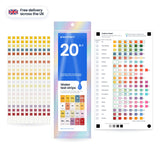
That depends on the fish. The Ornamental Aquatic Trade Association (OATA) says in its water quality leaflet that each species is adapted to water of a particular hardness or softness, which may differ from your tap water. You can compare your tap and your tank with a 20-in-1 WaterKit test strip, but first you need the target for your fish.
OATA publishes a care sheet for each group of fish, listed on its tropical freshwater and cold-water pages. We read three of the tropical sheets for this guide and not the goldfish or pond fish ones. OATA gives general hardness in dH and carbonate hardness in dkH.
| OATA care sheet | General hardness | Carbonate hardness | pH |
|---|---|---|---|
| Guppies and mollies | Medium-hard, 8 to 18 dH | Medium-hard, 5 to 15 dKH | 7.0 to 8.0 |
| African lake cichlids | Hard, 12 to 18 dH | Hard, 10 to 15 dKH | 8.0 to 8.6 |
| Catfish | Soft to hard, 4 to 18 dH | Soft to hard, 3 to 15 dKH | 6.0 to 8.0 |
Catfish and guppies suit a wide span, while African lake cichlids sit at the hard end. OATA says to check species-specific needs with your retailer before buying.
How do you lower water hardness in a fish tank?
Going by OATA, with proprietary products made to soften water, after checking the range for your fish. The OATA leaflet and care sheets we read give no step-by-step method. OATA's leaflet says proprietary products are available to raise, lower or maintain pH, or to harden or soften water, and that your OATA retailer can advise if your tap water is too hard or soft. It gives no amounts.
- Species first. If your tap already falls inside the range for your fish, the OATA sheets do not ask you to change it.
- Substrate. OATA's African lake cichlid sheet recommends fine coral sand or a similar substrate to buffer the water, so what is in the tank also matters.
- Ratios. The OATA sheets we read give no ratios for mixing tap water with other water, so we give none. Our tap water in a tank or pond guide covers the tap water side, and our reverse osmosis water guide explains what RO water is.
How fast should hardness change?
Gradually, in our reading of OATA, though no source we read gives a rate. The leaflet says a stable environment prevents sudden changes that may harm fish, and warns that if pH changes too suddenly the water could become too acidic or too alkaline for them.
OATA's species sheets recommend a partial water change of 25% at least once a week, with the replacement water treated with tap water conditioner to remove chlorine or chloramine. Our water change guide has more on change sizes.
Why might your tap or tank differ from the area figure?
The area figure is an average. Your tap and your tank may sit somewhere else, and a figure for the area does not tell you what comes out of your own tap. OATA says most water companies now have an online postcode checker that tells you whether your tap water is hard or soft, and our postcode hardness guide shows how to use one. The sources we read for this guide give no hardness figure for any UK area, so we give none.
“I would never lean on the area figure alone, because it is an average and your own tap and your tank can sit somewhere else. Dipping a strip in both on the same day is a sensible way to see whether they match before you change anything.”
The tank adds its own variation. OATA says to take the test sample from the main body of the aquarium, not the filter, and to test at least weekly. A coral sand substrate, which OATA recommends for African lake cichlids to buffer the water, is one reason a tank can sit away from the tap. A strip dipped in both on the same day shows whether they match, and our hardness testing guide covers the method.
What can a test strip show for tank hardness?
It can indicate whether your tap water and tank water sit on the same hardness step. Fill a clean glass with each, dip one strip, wait 30 to 60 seconds and match the pads to the chart, or enter the colours in the free results checker. Repeat after any change. We have not checked the strip against aquarium test kits, so treat a tank reading as an indication, and the last column is our own reading of the chart.
| Check | What OATA gives | Our strip chart (our reading) |
|---|---|---|
| Hardness | Ranges in dH, table above | Steps at 0, 25, 50, 100, 250 and 425 mg/L, with nothing between 100 and 250. The unit basis is unconfirmed, so we do not convert to dH. We have not compared the pad with an aquarium general hardness kit |
| Carbonate hardness | 3 to 15 dKH across the three sheets above | The carbonate pad has steps at 0, 40, 80, 120, 180 and 300 mg/L, and the total alkalinity pad at 0, 40, 80, 120, 180 and 240 mg/L. We do not convert either to dkH |
The strip has no ammonia pad, and we do not claim the bacteria test for aquarium water either. OATA says ammonia and nitrite should always be zero, so use an aquarium kit for those, as our aquarium testing guide explains.
Best pack: 20 strips, enough to dip your tap water and your tank on several days around any change, £5.99 (or £10.99 with a bacteria test), with free 2nd Class delivery on every order. See the kit
Your fish tank hardness questions
How to reduce water hardness in fish tank? How to reduce water hardness in aquarium? How to reduce hardness of water in fish tank? How to reduce aquarium water hardness?
The OATA leaflet and care sheets we read give no step-by-step method. OATA says proprietary products exist to soften water and your OATA retailer can advise.
How to lower water hardness in fish tank? How to lower water hardness in freshwater aquarium? How to lower water hardness in aquarium?
Start with the range OATA lists for your species. If your tap sits outside it, OATA points you to your retailer.
How to soften fish tank water?
OATA says proprietary products can soften water, and gives no amounts. The OATA leaflet and care sheets we read give no other method.
How to get water hardness down in aquarium? How to bring down water hardness in aquarium?
Slowly, going by OATA's advice to avoid sudden changes. None of the OATA documents we read gives a rate.
Sources
- Ornamental Aquatic Trade Association (OATA), How to understand and test water quality in freshwater aquariums (PDF dated September 2022; hardness differs by species, postcode checkers, products to harden or soften water, retailer advice, sudden changes, sampling and weekly testing; read 29 October 2026).
- OATA, Tropical freshwater fish care sheets (index page; undated; read 29 October 2026).
- OATA, Coldwater fish care sheets (index page; undated; read 29 October 2026).
- OATA, How to care for guppies and mollies (PDF dated September 2022; hardness, carbonate hardness and pH ranges, weekly 25% water change; read 29 October 2026).
- OATA, How to care for African lake cichlids (PDF dated September 2022; ranges, coral sand substrate to buffer the water; read 29 October 2026).
- OATA, How to care for catfish (PDF dated September 2022; ranges; read 29 October 2026).
- WaterKit, Water Test Kit (20-in-1 strip, 30 to 60 second read, optional bacteria test, free 2nd Class delivery on every order) and results portal. The strip-chart column is WaterKit's own reading of the colour chart steps.