

How often should you change fish tank water?
Share
The water looks clear and the fish look fine, so does the tank really need a water change this week? Here is what the RSPCA and the UK trade body say about how often, how much and how, and you can compare your own tap and tank water with a 20-in-1 test strip.
Short answer: Weekly, a part at a time. The Ornamental Aquatic Trade Association (OATA) says partial changes of up to 25% every week help remove waste. The RSPCA's aquarium page gives weekly 30% changes and a 10% siphon change in separate sections, and its winter page says about 10 to 20% every two weeks.
By Andrew Tomlinson, WaterKit · Last reviewed 29 October 2026
How often should you change the water in a fish tank?
About once a week, and only part of the water, according to the UK sources we read, although they give different amounts. The numbers below come from the RSPCA's and OATA's own pages. Because the figures vary, a 20-in-1 WaterKit test strip dipped in your tap water and your tank water on the same day gives you something to compare, as explained further down.
| Source | What it says about water changes |
|---|---|
| OATA, freshwater aquarium leaflet | Partial changes of up to 25% every week |
| RSPCA, aquarium page | Weekly 30% changes in its filter section, and "remove ten percent" with a siphon in its water change steps |
| RSPCA, aquarium page, if tests show ammonia or nitrite above 0 mg/L | Change half the water every day and keep testing until conditions improve |
| RSPCA, winter page | About 10 to 20% every two weeks, even in winter, for tanks and ponds |
OATA adds that how often and how much may vary with the species, tank size and number of fish, and says to ask your retailer if in doubt. We found no figure in these pages that sets a change size by tank volume. Our cloudy fish tank guide covers what to check if the water looks off.
How much water is 25% of my tank?
Work out the volume first, then take the percentage. The RSPCA says to multiply width, depth and height in centimetres and divide by 1,000 to get litres. Its example is a tank 60 cm wide, 30 cm deep and 30 cm tall, which holds 54 litres. On that tank, 10% is 5.4 litres, 25% is 13.5, 30% is 16.2 and 50% is 27. That is our own arithmetic, and it ignores the space taken up by gravel and decorations.
How do you change the water in a fish tank?
Take out part of the water, then add treated water at the right temperature. The RSPCA and OATA describe that order, and the only method either page describes is a siphon.
- Leave the fish in and siphon out part of the water. The RSPCA says to remove ten percent this way, and OATA lists a siphon cleaning device and a bucket in its equipment checklist.
- Never start the siphon by mouth, says OATA, which also says to cover open cuts before putting your hands in the tank and to wash them straight afterwards.
- Swish filter media in the water you removed and never under the tap. Both the RSPCA and OATA say tap water washes away or kills the beneficial bacteria.
- Treat the chlorine. The RSPCA says to add a dechlorinating product or leave the new water standing for 24 hours, and OATA names the same two options. Our chlorine removal guide covers the tap side.
- Match the temperature. The RSPCA says new water at a different temperature will shock the fish.
Separately, OATA says to check the water quality at least once a week, and the RSPCA says once a fortnight.
How do you change the water without harming the fish?
Keep each change partial, treat the new water and match its temperature, according to the RSPCA and OATA. The RSPCA says chlorine in tap water is harmful to fish and to the filter bacteria, and its winter page names chlorine and chloramine together as tap water chemicals that can damage gills, with gasping among the signs. The 24-hour standing advice we read refers only to chlorine, so see our chloramine guide if you are unsure what your supplier uses.
Can you keep a fish tank clean without changing the water?
None of the RSPCA or OATA pages we read says you can. The RSPCA says weekly changes dilute the waste the biological filter cannot break down. OATA says live plants help remove nitrate, but it still lists water testing and partial changes as routine maintenance. Both also point to the waste going in. The RSPCA's feeding page says it is better to underfeed than overfeed, because fish are more susceptible to poor water quality than to a lack of food.
Why might your tap water not match what the guides assume?
A figure for the area does not tell you what comes out of your own tap, and each change puts that tap water into the tank. OATA says nitrate levels in tap water can vary widely between areas and tells keepers to ask their local retailer about nitrate for the fish they keep. The RSPCA lists water source among the many factors that affect water quality, says chlorine is present in tap water, and says you cannot judge water quality by looking at it, since clear water does not always mean healthy water. Its fish health page says most of the conditions it lists are caused by poor water quality and to check your water quality first. OATA adds that nitrate is the end product of filtration and usually keeps rising while a filter matures, so a clear tank can still hold a different reading from the tap that fills it.
“I wouldn't rely on an area figure for what goes into your tank, because every water change uses whatever comes out of your own tap. Dipping a strip in the tap water and the tank water side by side is a sensible way to see whether they actually match.”
That is why a side-by-side dip is useful. A 20-in-1 strip in a glass of tap water and another in tank water shows whether the two sit on the same step for nitrate and pH. Our aquarium testing guide covers the wider routine.
What one reader found
One member of the UK Aquatic Plant Society forum, replying in a thread about water changes on a larger tank, wrote "I use a Python-style water changer on my 160-litre aquarium once a month". They switch the filter off, drain the old water, then match the new water's temperature using the hot and cold taps. They say they have done this for years with no ammonia or nitrite spike, and think chlorine, which they say most UK areas use rather than chloramine, takes longer to affect the beneficial microorganisms. It is one keeper's account, and a monthly change is less often than the weekly figures above. Shared on the UKAPS forum.
What can a test strip tell me on water-change day?
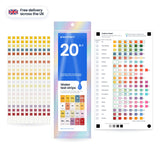
It can compare your tap with your tank on nitrate and pH, and indicate chlorine in fresh tap water. It has no ammonia pad. Fill a clean glass or cup with the water, dip one strip, wait 30 to 60 seconds and match the pads to the chart, or enter the colours in our free results checker by scanning the QR code on the chart. The last column is our own reading of the chart.
| Check | What the sources say | Our strip chart (our reading) |
|---|---|---|
| Ammonia | 0 mg/L (RSPCA). The RSPCA says ammonia and nitrite kits are essential | No pad. Needs a separate test |
| Nitrite | 0 mg/L (RSPCA), and OATA says zero before adding fish | First colour step is 1 mg/L, so a zero reading means none detected at that step, not none |
| Nitrate | OATA says tap water nitrate varies by area and to check species care sheets | Steps at 0, 10, 25, 50, 100, 250 and 500 mg/L, so tap and tank dipped together can be compared step by step |
| pH | OATA lists pH among the minimum tests | Steps at 6.2, 6.8, 7.2, 7.6, 7.8 and 8.4 |
| Chlorine in new tap water | The RSPCA says to treat it or let it stand 24 hours. We found no limit for tank water in these pages | Free and total chlorine pads start at 0.5 mg/L, so a zero reading cannot show lower levels |
Hardness has pad steps too, at 0, 25, 50, 100, 250 and 425 as printed on our chart, and our fish tank hardness guide covers what to do with it. Our results portal describes the total chlorine pad as free and combined chlorine together, but we have not tested it on chloraminated water. We do not claim the rapid bacteria test for aquarium water. A strip result is a quick comparison and not a laboratory analysis. Our home testing guide has the steps.
Best pack: 20 strips, enough to test your tap water and your tank across several water-change days, £5.99 (or £10.99 with a bacteria test for your drinking water tap), with free 2nd Class delivery on every order. See the kit
Your fish tank water change questions
How to change water in fish tank?
Siphon out part of the water, treat the new water and match its temperature, say the RSPCA and OATA. The steps are above.
How often should you change fish tank water?
About once a week, a part at a time. The table above has the OATA and RSPCA figures.
How often to change water in fish tank with filter?
The pages we read give no separate schedule. The RSPCA says no fish should be kept in a tank without a well set up and maintained filter, and still gives weekly changes. Its winter page says to clean the filter regularly but avoid over-cleaning.
How to change water in fish tank without killing fish?
Change only part of the water, treat it for chlorine and match the temperature. The RSPCA says new water at a different temperature will shock the fish.
How to change fish tank water without siphon?
The RSPCA and OATA pages we read describe only a siphon, and OATA lists a bucket and a siphon cleaning device as equipment. We found no other method in them.
How to do a water change on a tropical fish tank?
The steps are the same, with warm new water. The RSPCA says tropical tanks need a heater set for the species, for example 22 to 28 °C for guppies, and suggests a separate heater to warm new water before you add it.
Sources
- RSPCA, Choosing an Aquarium for Pet Fish (undated; weekly 30%, remove ten percent with a siphon, tank volume formula, filter media, dechlorinating or 24 hours, temperature, ammonia and nitrite 0 mg/L, half the water daily, fortnightly testing, heater; read 29 October 2026).
- RSPCA, Caring For Pet Fish In Winter (undated; 10 to 20% every two weeks, chlorine and chloramine; read 29 October 2026), What To Feed Your Fish (undated; underfeeding; read 29 October 2026) and Pet Fish Health (undated; check water quality first; read 29 October 2026).
- Ornamental Aquatic Trade Association (OATA), How to set up and maintain a freshwater aquarium (September 2022; up to 25% weekly, frequency varies, siphon by mouth, bucket and siphon in the equipment list, weekly testing, nitrate in tap water varies, plants and nitrate; read 29 October 2026).
- UK Aquatic Plant Society forum, How to condition tap water for large tank water changes (a member's reply; paraphrased; read 29 October 2026).
- WaterKit, Water Test Kit (20-in-1 strip, 30 to 60 second read, free 2nd Class delivery on every order) and results portal. The strip chart column and the litres example are WaterKit's own work.