

How do you test aquarium water at home?
Share
The water looks clear and the fish seem fine, but what is really in the tank?
Short answer: Use a colour-chart kit on a sample from the main body of the tank, says the Ornamental Aquatic Trade Association (OATA), at least once a week. Ammonia and nitrite should always read zero, and a minimum set covers 4 checks (ammonia, nitrite, nitrate and pH). OATA also says clear water does not mean good water quality.
By Andrew Tomlinson, WaterKit · Last reviewed 29 October 2026
How do you test aquarium water at home?
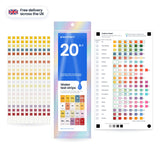
With a test kit that works by colour, says OATA's testing leaflet. Kits come as liquids, tablets or strips, and all work by matching a colour chart. OATA's freshwater set-up leaflet says the minimum is kits for ammonia, nitrite, nitrate and pH. You can also dip a 20-in-1 strip in the tap water you add, though it has no ammonia pad (details at the end).
- Take the sample from the main body of the tank, not from the filter, says OATA.
- Follow the kit's timings and match the result to its chart.
- If a test shows ammonia or nitrite is too high, OATA says to carry out partial water changes and keep up good husbandry, such as not overstocking or overfeeding.
Our fish tank water change guide covers how much to change.
What should my aquarium water test results be?
Zero for ammonia and nitrite, says OATA, and it says they should always be zero. OATA calls it a common mistake to think clear water means good water, because much pollution is invisible.
| Check | Target | OATA leaflet |
|---|---|---|
| Ammonia and nitrite | 0 mg/L | Freshwater and marine |
| Nitrate, freshwater | Check the species care sheet | Freshwater |
| Nitrate, marine fish-only | No more than 20 mg/L | Marine |
| pH, marine | 8.0 to 8.2 | Marine |
| Dissolved oxygen | At least 6 mg/L | Freshwater testing |
How often should I test my aquarium water?
At least once a week, ideally, says OATA. It adds that you may wish to test more often when setting up or adding fish, and that you should test if fish behave unusually, such as hanging at the surface or sitting on the bottom.
Can you test fish tank water without a kit?
Not by looking at it, according to OATA, but you can have it tested without a kit of your own. OATA says many of its retailers offer free water testing services and can advise on testing at home.
What about saltwater tanks and CO2?
Saltwater tanks need more checks, and the OATA leaflets we read give no test method for CO2.
- Saltwater. OATA's marine leaflet says to use a hydrometer or refractometer for salinity, with kits for ammonia, nitrite, nitrate and pH, adding phosphate, dKH, calcium and magnesium if you keep corals. For fish-only tanks it gives 1.017 to 1.023 SG, and 1.024 to 1.026 SG with invertebrates. For tanks with invertebrates it gives 8 to 12 dKH and phosphate of 0.04 to 0.1 mg/L, depending on species.
- CO2. OATA's planted tank leaflet says added CO2 is optional and that its dose should be carefully monitored for fish oxygen and pH swings, but it gives no test method.
Why might my tap water not match the area figure?
The area figure is an average. Your tap supplies the water you add at every change, and OATA's freshwater leaflet notes that nitrate levels in tap water can vary widely between different areas.
OATA also says water companies add chlorine or chloramine to tap water, and that both harm fish and the helpful bacteria in the filter, so a water conditioner is used. Our tap water in a fish tank guide and chloramine guide cover this.
“Averages are a starting point, not a verdict on your own tap, so I would always compare the area figure with what actually comes out of your tap before you rely on it for the water you add to the tank.”
OATA adds that each fish species is adapted to a particular hardness, which may differ from your tap's, and that most water companies have an online postcode checker. Our hardness guide shows how to find your area's figure, and our guide to lowering hardness in a fish tank covers the next step.
What can a test strip show for the water you add to the tank?
It indicates pH, hardness, alkalinity, nitrate and chlorine. Fill a clean glass with tap water, dip one strip, wait 30 to 60 seconds and match the pads to the chart, or enter the colours in our free results checker. We do not claim the strip for aquarium water or saltwater, and our rapid bacteria test is for drinking water, so we do not claim it for aquariums. Our home testing guide covers how the strip works.
| Check | OATA target | Our strip chart (our reading) |
|---|---|---|
| Ammonia | 0 mg/L | No pad. Needs a separate kit |
| Nitrite | 0 mg/L | First colour step is 1 mg/L, well above zero, so a zero reading means none detected at that step, not none |
| Nitrate | Species care sheet, or 20 mg/L at most for marine fish-only | Steps at 0, 10, 25, 50, 100, 250 and 500 mg/L, read on the tap water before it goes into the tank |
| pH | Marine 8.0 to 8.2 | Steps at 6.2, 6.8, 7.2, 7.6, 7.8 and 8.4, so a reading cannot be placed inside the 8.0 to 8.2 band |
| Hardness | Species differ | Steps at 0, 25, 50, 100, 250 and 425 mg/L. The unit basis is unconfirmed, so we do not convert to dH |
| Alkalinity and dKH | Reef 8 to 12 dKH | Steps at 0, 40, 80, 120, 180 and 240 mg/L. We do not convert to dKH |
| Chlorine in tap water | OATA says chlorine and chloramine harm fish | Free and total chlorine pads have a first step at 0.5 mg/L, so a zero reading means below that step. We have not tested the total pad on chloraminated water |
| Phosphate, CO2, oxygen, salinity, calcium | See above | No pad |
The area figure is an average, and OATA says nitrate levels in tap water can vary widely between areas, so your own tap may differ from it. The pads that matter here are nitrate, pH, hardness and chlorine on the water you add. A nitrate step above the one you expect points to more nitrate arriving with each change than the area figure suggests, a pH or hardness step that moves between tests points to a change in the water you add, and a chlorine reading above the first step means chlorine is present, which OATA says harms fish and filter bacteria. Best pack: 20 strips, enough to check the tap water you add on several water change days, £5.99 (or £10.99 with a bacteria test for your drinking water), with free 2nd Class delivery on every order. See the kit
Your aquarium water test questions
How to improve water quality in fish tank?
OATA advises partial water changes (up to 25% a week for freshwater, at least 10% for marine), no overstocking or overfeeding, and cleaning filter media in water taken from the tank, never under the tap.
How to test fish tank water? How do I test my aquarium water? How to test freshwater aquarium water?
Use a colour-chart kit on a sample from the main tank, as in the first section.
How to test aquarium water quality? How to test water quality in fish tank?
OATA gives ammonia, nitrite, nitrate and pH as the minimum.
How to test aquarium for ammonia?
With a separate ammonia kit, which OATA says should read zero. Our strip has no ammonia pad.
How to test fish tank water without kit?
The OATA leaflets we read give no home method, but many retailers offer free testing.
How to test saltwater aquarium water? How to test alkalinity in saltwater aquarium?
OATA says a hydrometer or refractometer for salinity and marine kits for the rest, including dKH.
How to test KH in aquarium? How to test phosphate levels in aquarium?
With separate kits, as OATA lists.
How to test CO2 in aquarium?
The OATA leaflets we read give no test method.
Sources
- Ornamental Aquatic Trade Association (OATA), How to understand and test water quality in freshwater aquariums (PDF dated September 2022; kit types, sample from the main tank, weekly testing, zero ammonia and nitrite, pH, dissolved oxygen, chlorine and chloramine, postcode checkers, behaviour signs; read 29 October 2026).
- OATA, How to set up and maintain a marine aquarium (PDF dated September 2022; hydrometer or refractometer, kits, parameter tables, free testing at many retailers; read 29 October 2026). The text layer of its parameter table is scrambled, so we read it by matching labels to values.
- OATA, How to set up and maintain a freshwater aquarium (PDF dated September 2022; test kits for ammonia, nitrite, nitrate and pH as a minimum, 25% weekly changes, nitrate in tap water varies; read 29 October 2026).
- OATA, How to set up and maintain a planted aquarium (PDF dated September 2022; supplementary CO2; read 29 October 2026).
- WaterKit, Water Test Kit (20-in-1 strip, 30 to 60 second read, from £3.99, free 2nd Class delivery on every order) and results checker. The strip chart column is WaterKit's own reading of the colour chart steps.