

What is a salt water pool?
Share
Part of our pool and hot tub water guide
The listing says salt water, or perhaps fresh water. What do the UK pool bodies mean by it, and what does the salt change? You can check your own pool and fill water with a 20-in-1 test strip.
Short answer: A salt water pool is a chlorine pool that makes its own chlorine from added salt. PWTAG says sodium hypochlorite can be generated electrically from sodium chloride, which also forms flammable hydrogen gas. SPATA, a UK trade body, gives a usual salt level of about 3,000 mg/l, roughly a tenth of sea water.
By Andrew Tomlinson, WaterKit · Last reviewed 29 October 2026
What is a salt water pool?
It is a chlorine pool in which the chlorine is made on site from salt. The Swimming Pool & Allied Trades Association (SPATA) describes the process in its salt chlorinator factsheet (C21, January 2026). A cell fitted in the plant room pipework, usually after the heater, passes a small current through the salty water and changes it into sodium hypochlorite. SPATA calls that the active chlorine disinfectant used extensively in swimming pools.
So the salt is the raw material and the chlorine is still the disinfectant.
How much salt is in a salt water pool?
SPATA says the pool is usually dosed to about 3,000 mg/l, also written as ppm. It describes that as about a tenth of sea water, giving a faint salty taste. The Pool Water Treatment Advisory Group (PWTAG) code of practice is written for public pools and lists domestic pools as not covered, though it says many of its principles can also be applied to them. None of the sources we read gives an official salt level for a home pool. SPATA tells installers to check other equipment against the salt level the chlorinator needs, so ask the maker of yours for its level.
What is a fresh water pool?
None of the sources we read defines the phrase. In PWTAG's code, fresh water is the fresh potable water used to dilute pool water, which is a different sense. In a holiday listing it most likely means a pool that is not salt-chlorinated. That is our reading, so ask the operator.
What do UK sources say a salt water pool still needs?
The same water testing as any chlorine pool, plus a few salt-specific points. PWTAG's code has a section on monitoring chlorine and pH, and our pool pH guide covers pH ranges and not mixing chemicals.
- Scale. SPATA says calcium scale tends to form on one of the electrodes, and most makers build in a device that reverses the current so the scale falls off. It says keeping pH, calcium hardness and total alkalinity within accepted bounds helps.
- Equipment and wiring. SPATA says the salt level has been found incompatible with some metal items in some pools. It also says salt raises conductivity, so when one is installed on an older pool, a thorough check of the electrical installation, particularly earth bonding, is advised.
- Hydrogen. PWTAG's technical note TN69 (June 2023) says a typical electrochlorination unit might produce over 7,000 litres of hydrogen a day. It says most systems dilute it and vent it outside, and recommends a hydrogen gas monitor on every system. Separately, the HSE says its pool guidance HSG179 does not apply to private domestic pools used solely by the owner, family and guests.
Can water softener salt be used in swimming pools?
The sources we read do not say either way. Our water softener guide explains how a softener uses salt. Ask your chlorinator's maker which grade suits.
Why might my pool not match the typical figures?
The figures above are typical figures from guidance, not readings from your pool. PWTAG says mains water, especially from a river or reservoir, is likely to contain organic materials, lime and other alkalis, phosphates (which it says encourage algal growth in the pool) and other substances that may exceed recommended limits if boosted by pool treatments. So scale on a chlorinator cell may differ between hard-water and soft-water areas (see how hard is my water), and algae, covered in our green pool water guide, can show up in some pools and not others.
“Your pool and your fill water are your own, so I would not lean on a typical figure when the source water can differ from one home to the next. Checking what is actually in yours is a sensible first step before you decide how to set up the treatment.”
What can a test strip show on a salt water pool?
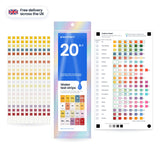
It indicates salt, free chlorine, pH and hardness as colour bands. Fill a clean glass or cup with the water, dip one strip, wait 30 to 60 seconds and match the pads to the chart, or enter the colours in the free results checker. We have not run strips in salt pool water, and the right-hand column is our own reading of the chart steps, not a claim from PWTAG or SPATA.
| Check | What the sources give | What our chart steps can show |
|---|---|---|
| Salt | About 3,000 mg/l (SPATA, trade body) | Steps at 0, 100, 250, 500, 1,000 and 2,000 mg/L. SPATA's figure sits above the top step, so the pad cannot read about 3,000 |
| Free chlorine | The ranges in PWTAG's code are for public pools, and we found no home pool figure | Steps at 0, 0.5, 1, 3, 5, 10 and 20 mg/L, to set beside the level your chlorinator's maker gives |
| pH | Ranges for public pools in PWTAG's code | Steps at 6.2, 6.8, 7.2, 7.6, 7.8 and 8.4. We give no verdict on a reading |
| Hardness of your fill water | No figure in the sources we read | Steps at 0, 25, 50, 100, 250 and 425, with the unit basis unconfirmed, so it is a rough guide to compare tap with tap |
Several things are outside what the kit does.
- It does not show how much chlorine the cell is making, whether the electrodes have scaled or what the hydrogen levels are.
- The results portal's wording for the salt pad is written for drinking water, so it does not apply to a pool sample.
- We do not claim the rapid bacteria test in the kit for pool water, and a strip result is not a legal sample.
For the method, see how to test your water at home.
The figures in this guide are typical values from guidance, and your pool can differ because PWTAG says mains fill water, especially from a river or reservoir, is likely to contain varying lime, alkalis and phosphates. The pads that matter here are free chlorine, pH and hardness. A change in the free chlorine pad would be a prompt to ask your chlorinator's maker about its setting, and a shift in pH or hardness would be a prompt to look at the scale point SPATA raises. Best pack: 20 strips, enough for 20 checks of salt, chlorine, pH and fill-water hardness, one a week through a season (our arithmetic), £5.99 (or £10.99 with a bacteria test for your tap water), with free 2nd Class delivery on every order. See the kit
Your salt water pool questions
What does fresh water pool mean? Is freshwater pool salt water?
Our reading is a pool that is not salt-chlorinated, so no. We found no UK official or trade-body definition, so ask the operator.
Sources
- Pool Water Treatment Advisory Group (PWTAG), Code of Practice: The management and treatment of swimming pool water (July 2021, last updated July 2025; written for public pools; scope 1.8, mains water quality 3.2, source water monitoring 3.3, dilution with fresh water 3.6; read 29 October 2026).
- PWTAG, Hydrogen safety in electrochlorination (TN69) (15 June 2023; written for pool operators; read 29 October 2026).
- Swimming Pool & Allied Trades Association (SPATA), Salt Chlorinators (C21) (dated January 2026 in the PDF; a trade body, so its figures are not official limits; read 29 October 2026).
- Health and Safety Executive, HSG179: Health and safety in swimming pools (fourth edition, 2018; paragraph 12 on pools not covered; read 29 October 2026).
- WaterKit, Water Test Kit (20-in-1 strip, 30 to 60 second read, 20 strips from £5.99, free 2nd Class delivery on every order, 30-day money-back guarantee) and results portal (salt, free chlorine, pH and hardness steps). The strip-chart table is WaterKit's own reading of the colour chart steps.
Contains public sector information licensed under the Open Government Licence v3.0.